

SEO for Vacation Rentals: The Nashville and Charleston Host's Complete Playbook

Updated: Sep 3

SEO for vacation rentals refers to the practice of optimizing your property's website and OTA listings so they rank higher in search engine results, attract qualified travelers organically, and generate direct bookings without paying platform commissions on every reservation. Done well, it is the single most cost-effective guest acquisition channel available to independent hosts in 2026.
Vacation rental SEO splits into two tracks: your own website (Google, Bing) and your OTA listings (Airbnb, Vrbo, Booking.com algorithms), and the strongest hosts optimize both simultaneously.
Long-tail, location-specific keywords like "bachelorette party house Nashville with hot tub" or "historic district Charleston vacation rental" convert far better than broad terms dominated by OTA giants.
Google's E-E-A-T framework (Experience, Expertise, Authoritativeness, Trustworthiness) now governs how vacation rental websites are ranked, making original, experience-based content a hard competitive requirement.
According to Booking.com's Partner Hub, properties with a 100% Property Page Score receive up to 18% more bookings than incomplete listings.
Nashville and Charleston represent two of the most distinct STR keyword universes in the country: bachelorette and event-driven searches in Nashville versus coastal escape and historic district searches in Charleston.
Technical factors including page speed and Core Web Vitals are ranking signals Google actively measures, and image-heavy vacation rental sites are disproportionately vulnerable to failing these benchmarks.
Table of Contents
Most Nashville and Charleston property owners treat SEO as an afterthought, something to consider after they have listed on Airbnb, posted a few photos, and waited for bookings to roll in. That approach worked five years ago. In 2026, OTA competition is fierce enough that organic search visibility has become the primary lever separating properties that consistently outperform their market from those stuck chasing occupancy with deep discounts.
Charleston's STR market alone has grown to 3,370 active listings, according to AirDNA data, with active listings climbing 8% year over year. Nashville's competitive pressure is, if anything, even more intense given the city's bachelorette and events market. Getting found by the right traveler, before they scroll to the third OTA result, requires deliberate strategy across multiple search environments. For hosts considering professional support, Nashville Airbnb Management services can help build that visibility from the ground up.
At Maverick STR, we work with property owners across both markets and nationwide on exactly this challenge. This guide covers the full framework: keyword strategy, on-page optimization, OTA algorithm mechanics, technical SEO, content planning, and the content gaps that most generic SEO articles completely miss, including Google Vacation Rentals integration, local schema markup, and Core Web Vitals for image-heavy sites.

Why SEO Matters More Than Ever for Vacation Rental Hosts in 2026
Vacation rental SEO matters because OTA commissions typically range from 15% to 20% of gross revenue on every booking, and that cost compounds year after year. A property generating $80,000 annually through Airbnb alone is surrendering $12,000 to $16,000 in fees. Organic search traffic, once established, drives bookings at near-zero marginal cost per reservation.
According to Skift Research's report on direct booking trends, travelers are increasingly bypassing OTA search in favor of direct property searches, particularly for premium and specialty accommodations. That shift is visible in Nashville's bachelorette segment and Charleston's romance travel category, where guests actively search for specific amenities rather than browsing generic OTA grids. Hosts exploring Vacation Rental SEO For Direct Bookings strategies are best positioned to capture this growing direct-search demand.
Search engine results now include AI-generated overviews, featured snippets, People Also Ask boxes, and Google's native vacation rental widget, all competing for the same top-of-page real estate. Hosts who invested in SEO in 2024 and 2025 are now capturing that visibility. Those who waited are starting from scratch in a more crowded landscape.
The good news: most individual hosts and small management companies have not done this work. The large OTAs dominate broad searches, but they cannot out-compete a well-optimized local property page for hyper-specific queries like "hot tub cabin near Nashville for 10 guests" or "pet-friendly Charleston vacation rental with parking." That is your competitive window. For more on Vacation Rental Marketing strategies that complement organic search, our resource library covers the full channel mix.
How Does Vacation Rental SEO Actually Work?
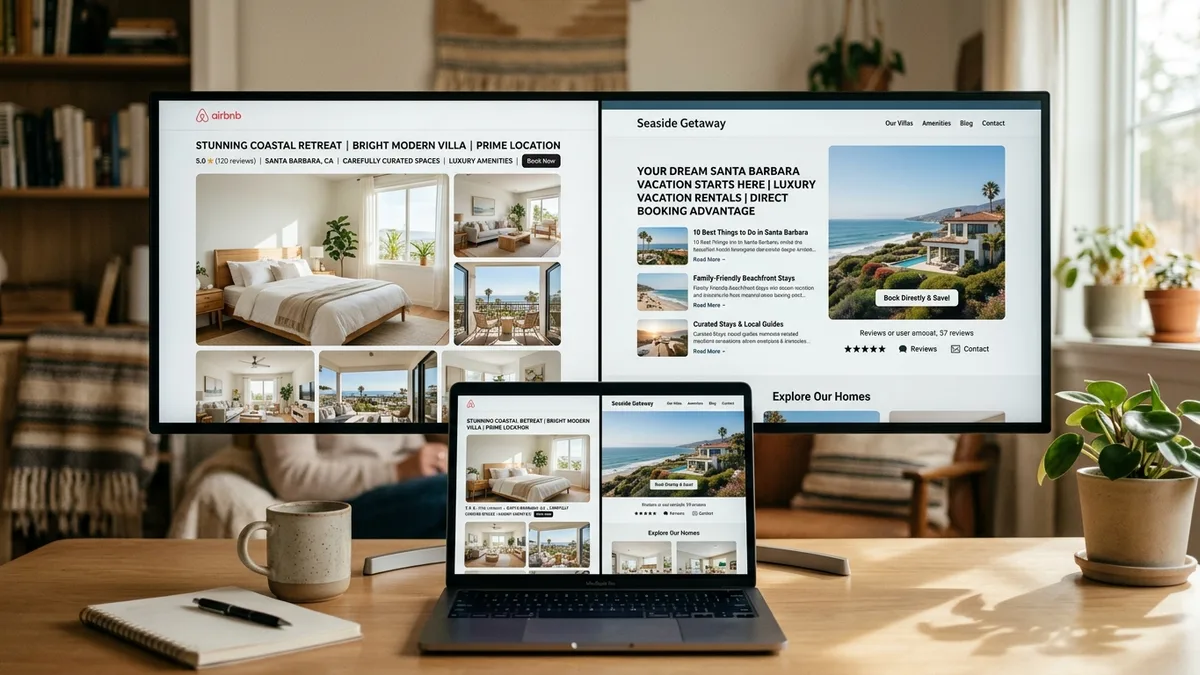
Vacation rental SEO operates across two parallel search environments: Google (and other traditional search engines) ranking your own website, and OTA platform algorithms ranking your listings within Airbnb, VRBO, and Booking.com. Each environment has distinct ranking signals, but they share one foundational principle: complete, relevant, trusted content wins.
For your own website, Google evaluates three broad categories: relevance (does your content match the searcher's query?), authority (do credible external sites link to you?), and technical quality (does your site load fast, display correctly on mobile, and follow indexing best practices?). Google's E-E-A-T framework, which stands for Experience, Expertise, Authoritativeness, and Trustworthiness, is the quality lens applied to every page. In an era saturated with AI-generated content, demonstrating real operational experience through specific property details, genuine guest insights, and local market knowledge is a genuine ranking differentiator.
For OTA listings, algorithms weight different signals. Airbnb's algorithm is primarily driven by click-through rate and conversion rate, according to Airbnb's official help documentation. A listing that appears in search but doesn't get clicked, or gets clicked but doesn't convert to bookings, will fall in ranking regardless of how good the description reads. Vrbo provides a Ranking Metrics tool in its host dashboard that shows exactly how your listing performs on each algorithm factor, making it one of the more transparent platforms for diagnosing visibility problems.
The unified insight most competitors miss: your website SEO and your OTA optimization reinforce each other. A well-trafficked direct booking site signals demand. Guest reviews built on OTAs provide authentic social proof you can reference on your website. High-quality photography and property descriptions developed for your website sharpen your OTA listings simultaneously. Treat them as one integrated system, not two separate projects. For a deeper look at optimizing SEO for vacation rentals, our dedicated guide covers the full technical and content framework.

What Keywords Should Nashville and Charleston Hosts Target?
Nashville and Charleston represent two of the most distinct STR keyword universes in the country, and no generic SEO guide accounts for this difference. Targeting the right city-specific terms is where local operators gain the most ground against national competitors. Our full collection of Vacation Rental SEO resources goes deeper on market-specific keyword research methodology.
Nashville Keyword Strategy
Nashville's search demand is heavily event-driven and group-oriented. The highest-intent searches combine occasion type, group size, and amenity: "bachelorette party house Nashville with hot tub," "large group rental Nashville sleeps 20," "Music Row Airbnb Nashville," and "SoBro vacation rental with rooftop." These phrases have meaningful search volume and almost zero competition from giant OTAs, because OTAs cannot rank a specific listing page for a hyper-local amenity query the way a dedicated property website can. Hosts managing Nashville Vacation Rental Properties should build their entire keyword map around these occasion-driven, amenity-specific phrases.
Nashville's event calendar also creates seasonal keyword spikes. CMA Fest, graduation weekends at Vanderbilt and Belmont, and the NFL season all drive distinct search surges. Building content around these events, not just listing availability, captures travelers at the research phase before they have committed to a booking platform. For a deeper look at maximizing revenue around these peaks, see our Nashville Airbnb Pricing Strategy: How To Maximize Revenue In Music City. Pairing keyword strategy with master dynamic pricing strategies for peak profits ensures your visibility translates to maximum revenue during those surges.
Charleston Keyword Strategy
Charleston travelers search differently. The dominant query patterns are location-anchored and experience-oriented: "historic district vacation rental Charleston," "Sullivan's Island beach house," "pet-friendly Charleston rental with parking," and "couples getaway Charleston SC." According to AirDNA data, Charleston's STR market averages an ADR of $396.10, reflecting premium demand from couples and family travelers willing to pay for the right property in the right neighborhood. Owners working with a Charleston SC Property Management team gain an advantage in identifying and targeting these high-converting local search terms. For a comprehensive look at what the data reveals, see our charleston str revenue data market analysis. Hosts new to the market can also review the ultimate guide for new Airbnb owners in Charleston to understand how keyword strategy fits into a strong launch plan.
Charleston also benefits from a $14 billion tourism economy in 2026, per the College of Charleston's Office of Tourism Analysis, which means underlying search volume for Charleston travel terms is substantial. The opportunity for individual hosts is to capture long-tail queries that describe their specific location and property type more precisely than any OTA category page can.
How to Find Your Best Keywords
Start with the Ubersuggest keyword research tool and type in your city plus your property's top amenity or location feature. Look for phrases with moderate monthly searches (50 to 500) and low keyword difficulty scores. You can compete for these; you cannot realistically compete for "Nashville vacation rental" against Airbnb's domain authority. Then validate your shortlist with free keyword tools like SEMRush, which reveals exactly which competitor pages rank for each term and how difficult displacement would be.
Vacasa's Director of SEO Nicole Jolma publicly advises that amenity-based keywords like "Colorado cabins with hot tubs" or "Michigan lake house rentals" perform exceptionally well for individual properties precisely because big OTAs cannot optimize a single listing page for those specific phrases. Apply the same logic locally: "Nashville duplex with dual hot tubs" or "Charleston carriage house rental historic district" are phrases where a dedicated property website can outrank any OTA. For more on this approach, see our guide on Airbnb SEO best practices. Exploring the vacation rental search engine optimisation local SEO tactics that work in competitive markets adds another layer to this keyword foundation.
How Do You Optimize Your Vacation Rental Website for Google?
On-page SEO for a vacation rental website follows the same structural rules as any content site, applied to the specific context of property pages and local search. The goal is to signal to Google exactly what your property is, where it is, who it serves, and why it is the best answer for a specific traveler's search query.
Title Tags and Meta Descriptions
Your page title should be 50 to 60 characters to avoid truncation in Google's search results. A Search Engine Journal study on Google title tag rewrites documented that Google rewrites title tags in a majority of cases, which means your title needs to clearly communicate the page's core subject so Google's rewrite stays on-message. A strong format: "[Amenity] Nashville Vacation Rental | Sleeps [N] | [Neighborhood]" or "Historic Charleston Rental | [Bedrooms] BR | Pet Friendly."
Meta descriptions do not directly influence rankings, but they drive click-through rate, which does. Write them as a 150 to 160 character pitch to the specific traveler you want. Include your top differentiating amenity, your location relative to a landmark, and one benefit. Avoid generic phrases like "book your stay today."
Keyword Placement Across the Page
Place your primary keyword in the page title, the H1 heading, one H2 subheading, the first paragraph of body copy, image alt text, and the URL slug. Secondary amenity and location keywords belong in H2 and H3 subheadings and throughout the body naturally. Keyword stuffing, repeating a phrase unnaturally every few sentences, triggers algorithmic penalties and alienates the human reader. One well-placed instance per page element is the rule.
URL Structure
Keep URLs short, lowercase, and descriptive: /nashville-bachelorette-rental-hot-tub/ outperforms /property-listing-12374?ref=home both for ranking and for human readability. Every additional folder level dilutes link equity, so avoid deep nesting where possible.
If you need a direct booking website built with these SEO principles baked in from day one, Maverick STR's direct booking website builder for short-term rentals is engineered specifically for this: structured for search, optimized for conversion, and designed to reduce OTA dependency over time. You can also explore how to build a direct booking website from scratch using SEO-first principles. For a full platform comparison, see our breakdown of vacation rental website builders. Hosts who want a purpose-built option can also review the build a vacation rental website guide for a step-by-step walkthrough. For hosts who want a deeper platform comparison, Vacation Rental Website Builders: Best Options for Hosts in 2026 covers the leading tools in detail.
How Do OTA Listing Algorithms Actually Rank Your Property?
OTA algorithms rank your listing based on a combination of listing quality signals, host behavior signals, and commercial signals. Understanding the weight each platform gives to these factors changes how you prioritize your optimization effort.
Airbnb Ranking Factors
Airbnb's algorithm prioritizes click-through rate and conversion rate above almost every other signal, according to Airbnb's official search ranking documentation. This means your primary photo and your listing title are the two most important elements on the platform, because they determine whether a searcher clicks, and your pricing and first-screen listing details determine whether that click converts to a booking request. A beautiful property with weak photography will underperform a mediocre property with a compelling hero image.
Airbnb also weights listing completeness heavily. The platform states that complete listings have a much easier time being picked up by their algorithm. Fill every field: house rules, check-in instructions, neighborhood description, all available amenities. Every empty field is a ranking penalty. Hosts using Airbnb Cohosting STR Management services benefit from having experts handle this listing completeness work systematically across every platform field.
Vrbo Ranking Factors
Vrbo's Ranking Metrics tool, accessible inside the host dashboard, shows you exactly how your listing performs on each parameter the algorithm weighs. Use it. Unlike Airbnb, which requires you to infer what is underperforming, Vrbo tells you directly. Rate parity is also a hard requirement: Vrbo's documentation states explicitly that offering lower rates on a competing platform will negatively impact your rank in their algorithm. Maintain consistent pricing across all channels. Our guide on 7 Best Channel Managers For STRs 2025 covers the tools that make cross-channel rate consistency manageable. For hosts managing multiple properties, the channel manager for short-term rentals guide shows how Charleston hosts save 20 hours weekly by automating rate parity.
Booking.com Ranking Factors
Booking.com's Property Page Score is the most transparent listing quality metric in the industry. According to Booking.com's Partner Hub, properties with a 100% Property Page Score receive up to 18% more bookings than properties with incomplete listings. They also recommend making your property available for bookings at least one year ahead, and some markets benefit from 18-month or even 24-month advance availability windows. Open your calendar further than feels comfortable. It directly affects where you appear in search results.
Response Rate and Speed
Every major OTA classifies any response to a guest message that takes longer than 24 hours as a late response, which actively suppresses listing visibility. This is non-negotiable if you want to maintain ranking. Use a property management system with automated messaging templates for the most common inquiries, particularly pre-booking questions about pet policies, parking, and check-in procedures. For practical frameworks on this, see our guide to effective guest communication strategies to boost booking management. Hosts who want to improve guest communication at scale can also review our Ultimate Guide To Guest Education For Direct Bookings for templates and frameworks that reduce response time while improving guest satisfaction.
What Is Google Vacation Rentals and How Do You Get Listed?
Google Vacation Rentals (GVR) is a native booking search feature that appears as a widget at the top of Google search results for travel queries like "Nashville vacation rentals" or "Charleston SC beach house rentals." It pulls listings directly from partner connectivity platforms and displays availability, pricing, and photos without requiring the traveler to leave Google. For direct-booking hosts, appearing in GVR is one of the most valuable organic placements available in 2026.
The most important thing to understand about GVR: you cannot list there directly as an individual host. Google pulls inventory through connectivity partners, specifically property management software platforms that have established data feeds with Google's travel products. To appear in GVR, your property needs to be connected through a compatible platform. Get your Lodgify booking engine set up, as Lodgify supports Google Vacation Rentals integration for properties that use their platform. If you are on a PMS platform that does not have GVR connectivity, switching to one that does can meaningfully expand your organic reach. For a review of the leading options, see our guide to the Top 8 PMS Integrations For Short Term Rentals.
Once listed, GVR rankings are influenced by availability completeness, price competitiveness relative to OTAs, and the quality of the property data feed. Keep your rates consistent with what you show on other channels and ensure your availability calendar is fully up to date. Stale or inaccurate data will suppress your placement.
This is one of the most underutilized distribution channels for Nashville and Charleston hosts, partly because most SEO guides focus exclusively on traditional search and OTA listings. Hosts who set up GVR connectivity now are capturing travelers who are still in the platform-selection phase of their research, before those travelers commit to Airbnb or Vrbo. Our guide on vacation rental SEO to drive more bookings covers GVR integration as part of a full multi-channel visibility strategy.
What Technical SEO Issues Kill Vacation Rental Website Rankings?
Technical SEO refers to the performance and structural factors Google measures independently of your content quality. For vacation rental websites specifically, image weight and page speed are the two issues most likely to suppress rankings despite strong content and good keyword strategy.
Core Web Vitals: What They Measure and Why They Matter
Google's Core Web Vitals are three specific performance metrics that serve as official ranking signals. Largest Contentful Paint (LCP) measures how long the main content of a page takes to load; anything slower than 2.5 seconds is a problem. Cumulative Layout Shift (CLS) measures visual stability, whether page elements jump around as the page loads. First Input Delay (FID) measures how quickly the page responds to the first user interaction. Vacation rental sites, which often load 20 to 40 high-resolution property photos on a single page, routinely fail LCP benchmarks.
The fix is straightforward: compress every image before uploading. TinyPNG's image compression tool reduces file sizes by 60% to 80% with no visible quality loss. Use WebP format instead of JPEG or PNG where your platform supports it. Lazy-load images below the fold so only the first two or three photos load on initial page render. These three changes alone will dramatically improve your LCP score.
Mobile Optimization
Google indexes the mobile version of your site first. If your property photos display correctly on desktop but overflow or load slowly on a phone screen, your rankings will reflect that mobile experience, not the desktop one. Test every page on an actual mobile device, not just a browser emulator. Pay attention to font size, button tap targets, and whether your booking calendar renders correctly on a small screen. Our guide to 5 tips to optimize direct booking sites for mobile covers these checks in detail.
Technical Audits for Larger Sites
If you manage multiple properties under one website, use the Screaming Frog SEO Spider to crawl your site and identify broken links, duplicate title tags, missing meta descriptions, redirect chains, and pages that are accidentally blocked from indexing. These technical errors silently suppress rankings and are invisible to the human visitor. A quarterly crawl takes under an hour and often uncovers issues that have been bleeding ranking potential for months.
Schema Markup: The Gap Almost Every Host Ignores
Schema markup is structured data code you add to your website that tells Google exactly what type of entity each page represents. For vacation rentals, the most valuable schema types are LodgingBusiness (which identifies your property as an accommodation), Offer (which surfaces pricing in rich results), and Review (which displays star ratings directly in search results). Almost no individual vacation rental host implements schema markup correctly, making it a genuine competitive advantage for anyone willing to learn or hire someone who knows it.
Proper LodgingBusiness schema should include your property name, address, phone number, check-in and check-out times, amenities list, and review aggregate. Once Google parses this structured data, your listing becomes eligible for enhanced search result formats that take up significantly more visual space in the SERP, which increases click-through rate without requiring any improvement in ranking position.
Our team at Maverick STR implements schema markup as part of every direct booking website build, because most hosts do not realize this technical layer exists until they wonder why a competitor's site shows star ratings in Google results and theirs does not. For hosts who want to explore the full range of Listing Optimization techniques available, schema markup is one of the highest-leverage technical investments you can make. Hosts managing properties across multiple cities can find platform-specific guidance in our top technology tools every Nashville STR owner needs overview. For a comprehensive review of the broader tech stack available to STR operators, the Ultimate Guide To STR Tech Tools For Property Managers In 2026 covers every major platform category.
How Do You Build Backlinks as a Vacation Rental Host?
Backlinks, meaning links from other websites pointing to yours, remain one of the strongest ranking signals in Google's algorithm. An Ahrefs backlink correlation study confirms that the number of referring domains pointing to a page is one of the most consistent predictors of high Google rankings. For vacation rental hosts, the most practical backlink sources are local and travel-specific.
Local Tourism and Convention Partnerships
Getting your property listed with local convention and visitors bureaus, tourism authorities, and chambers of commerce builds high-quality backlinks from authoritative regional domains. In Nashville, that means the Nashville Convention and Visitors Corp. In Charleston, it means the Charleston Area Convention and Visitors Bureau. These listings carry genuine link equity and increase your chances of appearing in tourist-facing resource pages that drive qualified, destination-motivated traffic.
Do not overlook neighborhood associations, wedding vendor directories (particularly relevant for Nashville's bachelorette market and Charleston's wedding destination category), and local event guides. Each relevant, contextually appropriate link adds to your domain authority over time. Hosts managing Nashville Vacation Rental Properties should prioritize Music City-specific tourism directories where local search authority compounds fastest.
Travel Blogs and Press Coverage
Reaching out to travel bloggers who cover Nashville or Charleston itineraries is a legitimate and effective link-building strategy when done correctly. The pitch should focus on what makes your property genuinely noteworthy: a specific amenity, an unusual design feature, or a location advantage. Generic "please review my rental" outreach is ignored. A specific angle, such as "the only Nashville rental with a dedicated speakeasy game room," attracts writers looking for content differentiation.
Social Platforms That Rank in Google
Keyword-optimized content on YouTube and Pinterest ranks directly in Google's search results, providing additional organic exposure. A YouTube walkthrough of your Nashville property titled "Nashville Bachelorette House Tour | Hot Tub, Rooftop Deck, Game Room" can appear in Google results for those same searches and funnel traffic to your direct booking site. Pinterest boards curating local Nashville or Charleston activities, linked back to your property, build topical relevance signals over time. For a tactical breakdown of social visibility, see our guide on how to use Instagram for STR marketing.
What Content Strategy Drives Organic Bookings for STRs?
Content marketing for vacation rentals works by attracting travelers who are in the research phase, before they have committed to a booking platform, and converting them into direct booking leads. A blog attached to your property website is the primary vehicle for this, but the content must be genuinely useful and specific to your destination. Explore the full range of Vacation Rental Marketing approaches in our resource library.
Write One Season Ahead
Vacasa's Director of SEO Nicole Jolma advises writing content "one season ahead" because travelers plan months in advance. If you want to capture Nashville summer bachelorette weekend searches, publish that content in late winter. Charleston spring break and Spoleto Festival content should go live in January. Google needs time to index and rank new content, and travelers need time to find it during their research phase. Publishing summer content in July is too late. For ideas on what to write, our list of 10 blog ideas for direct booking websites gives destination-specific starting points. You can also find proven data-driven strategies to promote your vacation rental that pair well with a content-first approach. Hosts focused on boosting occupancy rates for rentals will find that content published ahead of seasonal demand consistently outperforms last-minute promotional efforts.
Target the Full Travel Research Journey
Different content pieces serve different stages of the booking decision. A post titled "Best Neighborhoods to Stay in Charleston for Couples" captures the earliest research phase. "Things to Do Near [Your Neighborhood] in Charleston" captures mid-funnel travelers comparing specific areas. "What to Expect at [Your Property Name]: Honest Guest FAQ" captures bottom-of-funnel guests who have found your property and are deciding whether to book. All three types belong on your site, and they work as an interconnected cluster that signals topical authority to Google.
For a deeper framework on this approach, the ultimate guide to STR content marketing covers the full content architecture for short-term rental operators in detail.
Freshness and Consistency
Publishing frequency matters less than publishing consistency. One well-researched, genuinely useful post per month outperforms four rushed, thin posts. Google's helpful content system rewards pages that comprehensively answer the question a searcher had, not pages that cover a topic superficially to hit a target word count. Write for the traveler who is genuinely planning a trip to Nashville or Charleston, and optimize for search as a secondary layer, not the primary purpose. Our guide on how to get more direct bookings through SEO connects content consistency directly to booking conversion outcomes. Pairing a strong content strategy with email marketing to boost direct bookings creates a powerful full-funnel approach. For specific campaign ideas, our 5 email campaign ideas for STR bookings provides ready-to-use templates for Nashville and Charleston hosts. Hosts who want to build a long-term owned audience can also read our guide on how to build an email list for direct bookings.

How Do Website SEO and OTA Optimization Work Together?
Website SEO and OTA listing optimization are not competing priorities. They are complementary systems that reinforce each other when managed as a unified strategy. Hosts who treat them as separate projects leave significant performance on the table.
Signal | Website SEO Impact | OTA Algorithm Impact |
Professional photography | Increases time-on-page, reduces bounce rate | Directly drives click-through rate on Airbnb |
Complete property description | Keyword-rich content for Google indexing | Listing completeness score on all platforms |
Guest reviews | Review schema boosts SERP appearance | Core ranking signal on every OTA |
Response speed | Indirect (trust signal, reduces abandonment) | Direct ranking factor on Airbnb and Booking.com |
Availability calendar | Enables Google Vacation Rentals integration | Direct ranking factor; open calendars rank higher |
Consistent pricing | No direct SEO impact | Rate parity violations suppress Vrbo and Booking.com ranking |
The practical integration looks like this: develop your property's definitive description on your own website first, with full keyword optimization and complete amenity lists. Then adapt that description for each OTA's character limits and formatting requirements. Use the same high-quality photography everywhere. Collect reviews on OTAs, then display aggregated review data via schema markup on your website. Feed your availability calendar to Google Vacation Rentals through your PMS platform. Effective STR Revenue Management ties these channels together so pricing and availability stay consistent across every search surface. For a complete framework, our revenue management for vacation rentals complete 2026 guide walks through how pricing strategy and search visibility work as one integrated system. Hosts who want to understand the full revenue picture can also explore our Revenue Management resource library for deep-dive guides on pricing, competitor analysis, and occupancy optimization.
When you generate direct booking traffic through your website, you reduce your OTA revenue share without reducing total bookings. The guide to getting direct bookings for short-term rentals covers the full conversion funnel once organic traffic arrives at your property page.
SEO vs. Paid Ads: Which Should Vacation Rental Hosts Prioritize?
For most vacation rental hosts, SEO should be the primary long-term investment, with paid advertising as a short-term supplement during slow seasons or new property launches. SEO builds compounding value: rankings established today continue driving traffic six months from now without additional spend. Paid ads stop the moment your budget runs out.
That said, SEO is genuinely slow to produce results. Nicole Jolma of Vacasa characterizes it accurately: "SEO is a marathon, not a sprint." Most new property websites take three to six months to rank meaningfully for target keywords, longer in competitive markets. If you have a new property and need bookings next month, paid search campaigns targeting your specific amenity and location can fill that gap while your organic presence builds. For data on how SEO compares to paid channels for lead quality, the Databox survey on SEO effectiveness offers compelling evidence for prioritizing organic search investment. Hosts who want to pursue paid channels alongside SEO can review our guide on Google Ads for Vacation Rentals: Strategies That Actually Drive Bookings for campaign frameworks that complement organic growth.
The priority question also depends on your current position. If you have zero website traffic, the highest-ROI move is usually SEO: build the foundation first. If you have a functioning website with some organic traffic but empty weeks on your calendar, a targeted Google Ads or Meta campaign for your specific travel dates can be a precise, cost-effective fill strategy. Both tools belong in a mature STR marketing mix; neither should be the only one. Our post on direct bookings SEO and why it matters makes the long-term case for prioritizing organic over paid for portfolio growth.
For hosts who want to explore vacation rental marketing across both organic and paid channels, the two approaches become most powerful when your website's SEO foundation is strong enough that paid traffic has somewhere worth landing. Charleston hosts can also review unconventional vacation rental marketing secrets from Charleston's most successful hosts for channel strategies that go beyond standard paid and organic frameworks.
Your Vacation Rental SEO Action Plan
SEO for vacation rentals is not a single task. It is an ongoing system with distinct phases. Here is a sequenced action plan that prioritizes the highest-impact work first.
Audit your current position. Use Google Search Console (free) to see which queries currently send traffic to your website and which pages rank in positions 20 to 50, your fastest path to meaningful traffic improvements. Identify your top three to five target keywords using the Ubersuggest keyword research tool or SEMRush based on your property's location and top amenities.
Complete every OTA profile fully. Aim for Booking.com's 100% Property Page Score. Fill every Airbnb field including house rules, neighborhood guide, and guidebook recommendations. Open your availability calendar at least 12 months out on every platform.
Optimize your website's on-page elements. Update title tags, meta descriptions, H1 headings, and image alt text for your primary keyword on every key page. Compress all images using TinyPNG or a similar tool. Verify your site is mobile-responsive by testing on an actual phone.
Implement LodgingBusiness schema markup. Add structured data to your property pages so Google can display rich results including star ratings and pricing. If you built your website on a platform that does not support custom schema, this is a legitimate reason to consider a rebuild on a more SEO-capable foundation.
Set up Google Vacation Rentals connectivity. Confirm whether your PMS or booking platform has a GVR data feed. If not, research platforms that do and evaluate whether migration makes sense for your portfolio size. You can also book a call with Lodgify to explore their GVR integration options.
Build local backlinks. Submit your property to your city's CVB listing database, relevant neighborhood guides, and any local travel directories that serve your target traveler segment. Each submission is a link-building action that compounds over time.
Publish content on a consistent schedule. Start with two to three destination-focused posts targeting your primary traveler persona: bachelorette group planning guides for Nashville, couples weekend itineraries for Charleston. Write them one season ahead of the relevant travel period. For a complete content marketing framework tailored to STR operators, explore our Search Engine Optimization for Charleston STR Owners guide. Nashville hosts should also review the Nashville vacation rental marketing mistakes that cost owners thousands to avoid common pitfalls during this phase. Hosts in Nashville who want broader STR management context can also review what to look for in an STR management company in Nashville to understand how professional support can accelerate this content and SEO buildout. Charleston hosts looking for direct booking SEO benchmarks can also review our dedicated Vacation Rental SEO and Organic Traffic: The Charleston Host's Playbook for market-specific data and tactics.
Monitor and iterate quarterly. Review Google Search Console data every 90 days. Identify which pages gained ranking, which stalled, and where you are losing clicks to OTA results. Adjust your content and technical strategy based on what the data shows, not what you assumed would work.
The hosts who outperform their markets in 2026 are not the ones with the most listings or the deepest discounts. They are the ones who built a search presence that makes their property findable before a traveler ever opens the Airbnb app. That is what vacation rental SEO to drive more bookings accomplishes at its best.
Frequently Asked Questions
How long does SEO take to work for a vacation rental website?
Most vacation rental websites begin seeing measurable organic traffic improvements within three to six months of consistent SEO work, including on-page optimization, content publishing, and backlink building. Highly competitive markets like Nashville and Charleston may take closer to six to twelve months to rank meaningfully for target keywords. SEO produces compounding returns: the traffic you earn in month six continues growing in month twelve without additional spend, unlike paid advertising.
Can I do SEO on Airbnb and Vrbo listings, or only on my own website?
You can and should optimize both. Airbnb and VRBO each have their own internal search algorithms that function independently of Google. On Airbnb, click-through rate and conversion rate are the primary ranking signals according to Airbnb's official documentation. On Vrbo, their Ranking Metrics tool shows you exactly which factors affect your listing's visibility. These OTA optimizations operate separately from Google SEO but are equally important for overall booking performance.
What keywords should a Nashville vacation rental host target?
Nashville hosts should prioritize long-tail, occasion-specific, and amenity-specific phrases rather than broad terms like "Nashville vacation rental" that OTAs dominate. Strong targets include phrases that combine group type, occasion, and amenity: "bachelorette house Nashville hot tub," "large group rental Nashville sleeps 16," and neighborhood-specific terms like "SoBro Airbnb" or "Gulch vacation rental." Start keyword research with the Ubersuggest keyword research tool or Google Keyword Planner, filtering for phrases with 50 to 500 monthly searches and low competition scores.
What is Google Vacation Rentals and do I need to be listed there?
Google Vacation Rentals is a native booking search feature that displays vacation rental inventory directly in Google search results for destination queries. It is one of the most valuable organic placements for direct-booking hosts because it intercepts travelers before they open Airbnb or Vrbo. To appear in Google Vacation Rentals, your property must be connected through a compatible property management software or booking engine platform that has established a data feed with Google's travel products. Individual hosts cannot list directly without a connectivity partner.
How does page speed affect vacation rental website rankings?
Page speed is an official Google ranking signal through the Core Web Vitals program. Vacation rental websites are particularly vulnerable because they typically load many high-resolution property photos, which creates large page file sizes that slow Largest Contentful Paint (LCP) scores. Google considers LCP times above 2.5 seconds to be problematic. Compressing images before upload using a tool like TinyPNG, using WebP image format, and implementing lazy loading for below-fold photos are the three highest-impact technical fixes for most vacation rental sites.
Does my vacation rental need a direct booking website, or is ranking on Airbnb enough?
Ranking well on Airbnb is valuable but insufficient for long-term revenue optimization. OTA commissions, which typically run 15% to 20% of gross revenue, are a permanent cost of OTA-only distribution. A direct booking website, once ranking organically on Google and listed in Google Vacation Rentals, captures bookings at near-zero marginal cost per reservation. The most profitable vacation rental businesses in 2026 use a hybrid model: OTAs for reach and initial reviews, direct booking channels for margin protection and guest relationship ownership. Our guide on transitioning from OTA to direct bookings walks through this shift step by step.
What is schema markup and why does it matter for vacation rental websites?
Schema markup is structured data code added to your website that helps Google understand exactly what type of entity each page represents. For vacation rentals, LodgingBusiness, Offer, and Review schema types make your property eligible for enhanced search result formats that display star ratings, pricing ranges, and property details directly in Google search results. These rich results occupy more visual space in the SERP and typically generate higher click-through rates than standard blue-link results. Schema markup is one of the most underused technical SEO tools among individual vacation rental hosts.
Building a Search Presence That Compounds Over Time
SEO for vacation rentals is one of the few marketing investments that gets more valuable the longer you maintain it. Every piece of content you publish, every backlink you earn, every technical improvement you make to your site's speed and structure adds to a foundation that keeps driving bookings without ongoing ad spend. The hosts who are hardest to compete with in Nashville and Charleston two years from now are the ones building that foundation today.
The framework is clear: target the hyper-local, occasion-specific, and amenity-based keywords your competitors ignore. Optimize both your direct booking website and your OTA listings as a unified system. Implement technical fixes for page speed and schema markup that most hosts never address. Get connected to Google Vacation Rentals before your market peers figure out it exists. Publish destination content one season ahead of your target travel period and build local backlinks through CVB listings and travel partnerships.
None of this is fast. But the compounding effect is real. A Charleston property that averaged $58,200 in annual revenue at market rates, per AirDNA data, can meaningfully outperform that benchmark when direct bookings reduce the OTA commission drag. The properties in Maverick STR's portfolio that have built strong direct booking channels consistently demonstrate this: reducing platform dependence and growing organic traffic creates a revenue profile that self-manages market downturns better than OTA-only properties can. Owners curious about what professional management delivers can read our breakdown of the best property management companies in Charleston SC and our companion piece on the best Airbnb management companies in Nashville. For hosts exploring co-hosting or lead generation opportunities, our Co Host Lead Generation resources outline how to grow a managed portfolio alongside your own organic search strategy.

If you want professional SEO strategy applied directly to your vacation rental, Maverick STR works with short-term rental operators nationwide on vacation rental SEO to drive more bookings, from keyword research and on-page optimization to direct booking website builds that have generated 3-5x organic traffic growth within three months for clients across the country. Properties in our managed portfolio consistently outperform their local market by 50% or more, and that gap starts with being found before the competition. Connect with the Maverick STR team to start building your search presence.



Comments