

How to Build a Rental Booking Website That Converts


A rental booking website is a custom, host-owned site where guests can browse your property, check availability, and complete a reservation without routing through Airbnb or VRBO. At Maverick STR, we have built more than 45 direct booking sites for short-term rental hosts and property management companies nationwide, and the single most consistent finding is this: owners who launch a properly structured direct booking site reduce their OTA commission exposure by thousands of dollars annually while building a guest list they actually own.
A rental booking website is a direct-booking channel that eliminates OTA commissions, typically ranging from 3% to 15% per reservation on platforms like Airbnb and VRBO.
The U.S. short-term rental market is projected to reach $8.9 billion in valuation by 2026, according to Research and Markets, making a standalone web presence increasingly important for competitive differentiation.
Purpose-built STR platforms such as Lodgify, Hostaway, and Guesty include integrated booking engines, availability calendars, and channel-sync tools specifically designed for vacation rental operators.
SEO is the highest-return marketing channel for direct booking sites: Maverick STR clients have seen 3 to 5 times their monthly organic traffic within the first three months of launching an optimized property site.
Every direct booking site needs five core components: a booking engine, a payment processor, real-time availability sync, a mobile-responsive layout, and local SEO structure targeting destination-intent searches.
Legal compliance on your site, including a privacy policy, cookie notice, rental agreement, and local permit display, is not optional in 2026. Many U.S. municipalities require permit numbers to appear on all booking channels.
What Is a Rental Booking Website and Why Does It Matter?
A rental booking website is an independently owned property site where travelers reserve a vacation rental directly with the host, bypassing third-party marketplaces. The site typically includes a property description and photo gallery, a real-time availability calendar, a booking engine with payment processing, and direct contact or inquiry options. Unlike an Airbnb listing, the host controls the pricing, the cancellation policy, the guest communication, and the brand identity from the first page view to checkout.
The financial case is straightforward. Airbnb charges guests a service fee and hosts a separate host fee. Combined, those charges can represent 15% or more of each transaction, depending on the booking structure. A direct booking on your own site eliminates both. For a property generating $80,000 annually through OTAs, shifting even 30% of bookings to direct channels could save $3,600 or more per year, before counting the long-term value of a guest email list you own and can remarket to without platform permission.
The competitive case is equally strong. According to the Skift Research report on direct booking trends, travelers are increasingly comfortable booking through property websites when those sites are professionally designed and clearly trustworthy. A well-built site signals professionalism. A missing or outdated one signals the opposite.
In 2026, with the U.S. STR market growing at roughly 19% annually through 2032 according to Research and Markets, the hosts who invest in owned booking infrastructure now are building a compounding advantage over those who remain entirely OTA-dependent.
What Is the Most Popular Rental Website?
The most popular rental websites for vacation accommodations are Airbnb and VRBO, which together dominate short-term rental discovery traffic in the United States. Airbnb reported over 7 million active listings globally as of its most recent disclosures, and VRBO (owned by Expedia Group) remains the leading platform for whole-home vacation rentals in North American leisure markets.
But popularity for guests and value for hosts are two different things. Both platforms charge transaction fees, restrict your access to guest contact information, and can delist or suppress your listing based on algorithm changes outside your control. That dependency is exactly why building your own rental booking website has become standard practice for serious STR operators.
For hosts not ready to build a standalone site, metasearch aggregators such as Trivago and Google Hotel Ads can drive traffic to a direct booking page at a lower cost than OTA commissions. For property management companies building their own client-facing presence, platforms like Guesty and Hostaway include built-in website builder tools that connect directly to your property management system. As described in Guesty's guide to creating a booking website for vacation rentals, these integrated tools auto-sync calendars, rates, and channel connections, which eliminates the most common setup error: double-bookings from mismatched availability data.
What Is the Best Site for Renting Out a Vacation Property?
The best site for renting out a vacation property depends on your specific goals, but the correct long-term answer is your own direct booking website supported by selective OTA distribution. No single third-party platform gives you full control over pricing, policies, branding, and guest data simultaneously. The smartest operators use Airbnb and VRBO for discovery while routing returning guests and high-intent organic searchers to a direct booking channel where no commission is owed.
For building that direct channel, Lodgify is one of the most widely used purpose-built platforms for vacation rental hosts. As outlined in Lodgify's direct booking website guide, the setup process covers five steps: start a free trial, configure your property details, build the site from templates, connect PayPal or Stripe for payments, and sync external channels including Airbnb and VRBO. Lodgify claims you can import an existing Airbnb listing in approximately 2 minutes, which significantly reduces the time-to-launch for hosts migrating from a pure OTA strategy.
Hostaway offers a comparable builder with pre-built templates and a booking engine that accepts reservations within minutes of setup. Wix provides a more design-flexible option with AI-generated layout tools and integrated availability calendars, though it requires more manual configuration for channel sync. For a no-cost entry point, VacationRentalDesk offers a free vacation rental website builder with basic online booking software and a photo gallery, which suits single-property owners just starting to capture direct bookings before investing in a premium platform.
The honest recommendation: if you manage one to three properties and want a fast, low-maintenance solution, Lodgify or Hostaway will serve you well. If you want maximum design flexibility and plan to build a real brand, consider a professionally designed direct booking site built to rank on Google, not just accept bookings.
Who Is Airbnb's Biggest Competitor for Vacation Rentals?
Airbnb's biggest direct competitor in the vacation rental segment is VRBO, operated by Expedia Group. VRBO focuses exclusively on whole-home rentals, which makes it a stronger fit than Airbnb for property owners listing houses, cabins, and group-capacity properties. In markets like Nashville and Charleston, where the dominant rental product is an entire home with amenities like hot tubs, game rooms, and outdoor spaces, VRBO listings frequently outperform Airbnb on a per-booking revenue basis because the platform attracts longer-stay, higher-budget leisure travelers rather than short weekend guests.
Beyond VRBO, Booking.com, HomeAway, and Agoda represent meaningful secondary distribution channels, particularly for properties that attract international visitors. TripAdvisor Rentals connects listings to one of the world's most trusted travel research platforms. But none of these platforms resolve the fundamental issue with OTA dependency: they own the guest relationship, not you.
The most effective competitive strategy for individual hosts is not to pick the best OTA and abandon the others. It is to build an owned booking channel, use OTAs selectively for new guest acquisition, and redirect repeat visitors to your SEO-optimized direct booking site where you keep 100% of the booking revenue. That is the model Maverick STR implements for its clients, and it is why well-managed direct booking sites consistently outperform OTA-only strategies over a 12-month horizon.

How Do You Build a Rental Booking Website Step by Step?
Building a rental booking website for a short-term rental requires assembling five functional components: a domain and hosting foundation, a property management-compatible website platform, a real-time booking engine with payment processing, channel synchronization to avoid double-bookings, and an SEO structure that targets destination-intent search queries.
Step 1: Choose Your Platform
For most vacation rental hosts, a purpose-built STR platform outperforms a generic website builder like Wix or WordPress from the start, primarily because channel sync and booking calendar logic are built in rather than bolted on. Lodgify, Hostaway, and Guesty's website tool are the most commonly deployed in 2026. If you manage multiple properties, Guesty's platform includes built-in website features that auto-integrate with channels, calendars, and messaging tools, as noted in their direct booking guide. For a done-for-you approach with SEO architecture included from day one, a custom-built site built by a specialist team is worth the additional investment.
Step 2: Configure Your Property Details and Photography
Your property page is the highest-converting page on the site. Invest in professional photography before launch. Properties with professional images consistently outperform self-photographed listings in click-through rate and booking conversion. List every amenity specifically, as search engines and booking guests both scan for specific terms like "7-person hot tub" or "game room with pool table" rather than generic descriptors like "entertainment options."
Step 3: Set Up Payment Processing and Booking Logic
Connect Stripe or PayPal as your payment gateway. Both Lodgify and Hostaway support both processors natively. Configure your minimum stay requirements, pricing rules, damage deposit or waiver structure, and cancellation policy before launch. Set up automated booking confirmations and pre-arrival messaging through your property management system so guests receive communication immediately upon booking, the same standard OTA platforms have conditioned them to expect.
Step 4: Sync Your Availability Calendar
Connect your iCal feeds from Airbnb, VRBO, and any other active channels to your direct booking site. Most platform builders handle this natively. Without calendar sync, you risk double-bookings, which damage your reviews across every channel simultaneously. This is the setup step most self-managed hosts get wrong, and it is one reason Maverick STR builds calendar sync verification into every site launch checklist.
Step 5: Build Your SEO Foundation
An online booking page with no search visibility is an expensive brochure. Your site needs title tags, meta descriptions, and page content that target how real travelers search, typically location-plus-type queries like "Nashville bachelorette rental with hot tub" or "Charleston group rental with private pool." Set up a Google Business Profile for your property, as local listings appear in map results and drive high-intent traffic. Add schema markup for your rental property so search engines can display availability, pricing, and review data directly in search results. For a deeper dive into this process, the vacation rental SEO guide covers the full technical and content strategy.
What Features Does a Rental Booking Website Actually Need?
A rental booking website needs six functional components to convert visitors into paying guests without friction. Missing any one of these creates a drop-off point where a potential guest abandons the site and books through an OTA instead.
Feature | Why It Matters | Platform Support |
Real-Time Availability Calendar | Prevents double-bookings, sets guest expectations | Lodgify, Hostaway, Guesty, Wix |
Integrated Booking Engine | Captures reservations without redirecting to OTAs | Lodgify, Hostaway, Guesty |
Secure Payment Processing | Accepts credit cards; builds guest trust | Stripe, PayPal (via most platforms) |
Channel Synchronization | Syncs calendars across Airbnb, VRBO, and direct | Lodgify, Hostaway, Guesty |
Mobile-Responsive Design | Over 60% of web traffic arrives on mobile devices (StatCounter, 2026) | All platforms with quality templates |
SEO-Optimized Content Structure | Enables organic Google rankings for destination queries | Custom builds, Lodgify, CraftedStays |
Guest Communication Tools | Automated confirmations, pre-arrival messages | Guesty, Hostaway, Lodgify |
Legal Pages (Privacy, ToS, Rental Agreement) | Required for GDPR, CCPA, and local permit compliance | Must be added manually to most platforms |
Mobile responsiveness deserves specific emphasis. According to StatCounter's global device market share data, more than 60% of all website visits now originate from mobile devices. A vacation rental site that does not reflow elegantly from a 27-inch desktop monitor to a 375-pixel phone screen will lose a majority of its potential bookers before they ever reach the checkout step. This is not a design preference in 2026; it is a basic conversion requirement.
The legal pages section is consistently underbuilt. Most DIY vacation rental sites launch without a privacy policy, a cookie consent notice, or a rental agreement that guests can review before booking. Many U.S. cities, including Nashville, Tennessee, require short-term rental permit numbers to be displayed on every booking channel. Nashville's Metro Government issues STR permits, and the permit ID must appear on your direct booking site the same way it appears on your Airbnb listing. Skipping this is a compliance risk, not just a legal formality.

How Do You Drive Traffic to a Rental Booking Website?
Driving traffic to a rental booking website requires a deliberate multi-channel strategy because organic search alone takes time to build, and paid channels alone are expensive to sustain. The most effective approach layers organic SEO as the long-term foundation with paid search and metasearch distribution as shorter-term accelerants.
Organic Search (SEO)
Vacation rental SEO targets how travelers search for properties by destination and amenity type, not by property name. A traveler looking for a Nashville group rental does not search for your property's brand name. They search "Nashville house rental with hot tub for 10" or "bachelorette property Nashville private backyard." Your site needs content and technical structure that matches those queries. Based on what we see at Maverick STR across our portfolio of over 45 direct booking sites, the properties that rank and convert consistently share three things: destination-specific page titles, amenity-rich descriptions written for both search engines and humans, and a Google Business Profile that surfaces in map results for local accommodation searches.
Paid Search via Google Hotel Ads and PPC
Google Hotel Ads allows your property to appear in hotel and vacation rental search results alongside OTA listings, with a direct link to your booking page. This is one of the most cost-effective paid channels for STR operators because you only pay for clicks from travelers actively searching in your destination. Combined with a well-structured vacation rental marketing strategy, paid search can deliver immediate booking volume while your organic rankings are still building.
Email Marketing to Past Guests
Past guests who had a positive experience are your highest-conversion audience. An email list of 200 previous guests will outperform $500 in paid advertising almost every time. Collect guest emails through your booking flow, then send targeted campaigns for repeat stays, referral incentives, or seasonal promotions. Platforms like Mailchimp make this straightforward to automate. The key is to send offers to your own audience rather than paying Airbnb to surface you to strangers for every booking. For a structured approach to this channel, the guide on how email marketing boosts direct bookings covers the full sequencing strategy.
What Does a Well-Performing Rental Booking Website Actually Look Like?
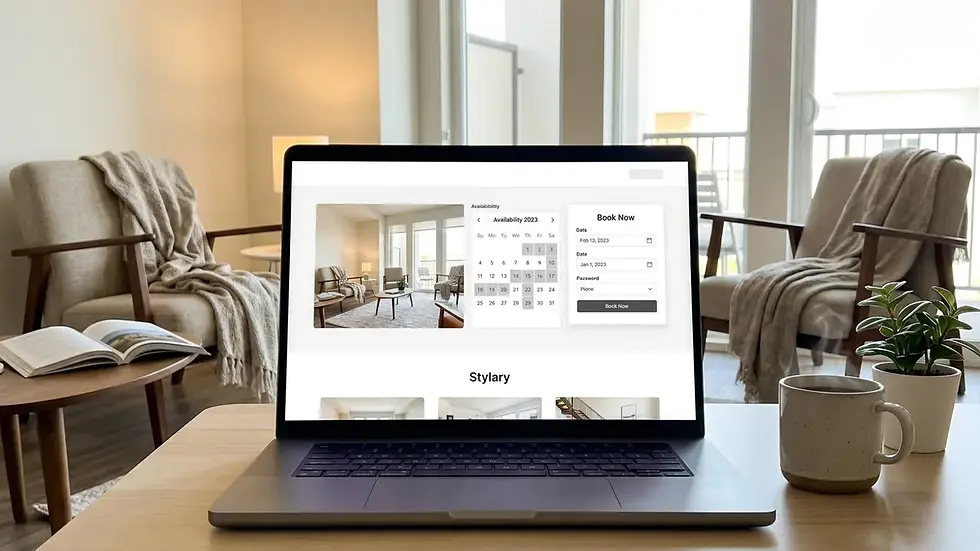
The best-performing direct booking sites share a specific structural pattern that consistently outperforms template-only builds. They open with a hero image that leads with the property's strongest amenity, not just an exterior shot. They place the booking widget above the fold on desktop and within two scrolls on mobile. They use descriptive H1 and H2 headings that include destination keywords, and they populate the property detail page with content that answers the questions a real guest would ask before booking.
Consider how properties in the Maverick STR portfolio are positioned. Underwood Manor, a 3-bedroom Nashville house that sleeps 10, is marketed around its moody speakeasy game room with pool table and whiskey barrel bar, its 7-person hot tub, and its location just 5 minutes from downtown Nashville. The direct booking site for a property like this works best when those specific amenities appear in page titles, meta descriptions, and the opening section of the property description, because those are the exact terms bachelorette party planners and group travelers search for. Generic descriptions like "fully furnished home near downtown" do not rank. Specific ones do.
The same logic applies across property types. The Herman Haven's private en-suite bathroom for every bedroom and its pet-friendly, wheelchair-accessible status are differentiators that belong in the site's technical metadata, not buried in the fifth paragraph of a property description. Every specific, verifiable amenity is a search ranking opportunity and a booking conversion signal simultaneously.
One property Maverick STR managed was projected to generate $60,000 in year one. With professional site structure, listing optimization, and an active direct booking channel, it generated $100,000. That performance gap is not accidental. It is the result of treating the booking website as a revenue asset, not just an information page.
What Are the Legal Requirements for a Rental Booking Website?
Legal requirements for a rental booking website in the United States fall into four categories: platform-level compliance, local permit and tax obligations, data privacy law, and guest protection documentation. Each category carries real enforcement risk, and most self-built sites are incomplete in at least two of them.
First, local permitting. Many U.S. cities require short-term rental hosts to display a valid STR permit number on every booking channel, including their own direct booking sites. Nashville's Metro Government issues short-term rental permits, and Nashville STR hosts are required to include their permit number on all listing platforms. Several U.S. municipalities also impose transient occupancy taxes ranging from 5% to 15% of gross rental revenue. Depending on your city, this tax may be remitted by the platform (Airbnb handles this in many jurisdictions) or directly by the host through your own booking site. If guests book through your direct site and you are in a jurisdiction where the platform does not collect the tax on your behalf, the remittance obligation falls on you.
Second, data privacy. The California Consumer Privacy Act (CCPA) and analogous state laws require websites that collect personal information, including guest names, emails, and payment data, to publish a privacy policy describing what is collected and how it is used. A cookie consent notice is also required for sites serving visitors from states or countries with active data privacy regulations.
Third, guest documentation. Every direct booking site should include a rental agreement that guests acknowledge before confirming a reservation. This document covers house rules, damage liability, cancellation terms, and guest identification requirements. Without a signed rental agreement, your recourse in a damage dispute is significantly weaker, regardless of what your platform terms of service say.
Fourth, platform compliance. If you use Airbnb or VRBO as distribution channels in addition to your own site, both platforms have terms of service that restrict certain types of off-platform solicitation. Review those terms before including contact information or discount incentives for direct booking on your OTA listing descriptions.
Frequently Asked Questions
How much does it cost to build a rental booking website?
The cost of a rental booking website ranges widely depending on the approach. DIY platforms like Lodgify and VacationRentalDesk start at free to approximately $50 per month for basic plans. Professionally designed custom sites built by an STR-focused agency typically range from $1,500 to $5,000 or more for initial development, depending on the scope. The correct question is not what the site costs to build but what it returns. A site that captures 20% more bookings at zero commission pays for itself within a single booking season for most properties.
Do I still need Airbnb if I have my own booking website?
Yes, for most hosts, maintaining Airbnb and VRBO distribution alongside a direct booking website is the right strategy in 2026. OTAs provide discovery traffic you cannot replicate overnight with organic search. The goal is not to abandon OTAs immediately but to shift the balance over time. Start by routing repeat guests and email subscribers to your direct site while keeping OTA listings active for new guest acquisition. As your organic search rankings build and your direct booking conversion improves, you can gradually reduce OTA dependency.
What is the best platform for building a vacation rental booking website?
For most individual hosts, Lodgify provides the best balance of ease of use, channel sync reliability, and booking engine quality. Hostaway is a strong alternative with slightly stronger property management system integrations. Guesty is better suited to multi-property operators who need a unified dashboard for guest communication, pricing, and calendar management alongside the website tool. For operators who want a professionally designed, SEO-optimized site without configuring a platform themselves, a done-for-you build from a specialist team delivers the highest ROI per booking.
How long does it take to rank a rental booking website on Google?
Early ranking signals from a well-structured vacation rental site typically appear within 4 to 6 weeks of launch, including indexing in Google Search Console and initial positioning for low-competition long-tail queries. Meaningful organic traffic growth, meaning consistent daily visitors from search, generally appears by the end of the third month when the site is properly optimized. Maverick STR clients have seen 3 to 5 times their monthly organic traffic within the first 90 days of an optimized site launch. Competitive market keywords take longer, often 6 to 12 months to rank well.
What payment processors work with vacation rental booking websites?
Stripe and PayPal are the two most widely supported payment processors for vacation rental booking websites. Stripe is generally preferred by professional operators because it offers lower fraud rates, better dispute management, and more flexible payout scheduling. Both processors integrate natively with Lodgify, Hostaway, and most other purpose-built STR website platforms. Whichever processor you choose, configure it to collect the damage deposit or waiver fee at the time of booking, not at check-in, to protect yourself from no-shows and last-minute damage claims.
Do I need an SSL certificate for my rental booking website?
Yes. An SSL certificate, indicated by the "https://" prefix and padlock icon in browser address bars, is required for any site that collects personal information or processes payments. Without SSL, major browsers display a "Not Secure" warning that immediately undermines guest trust and will cause most visitors to abandon the booking flow. Most hosting platforms and website builders include SSL certificates at no additional charge as of 2026. Verify yours is active before directing any guests to your direct booking URL.
How do I prevent double-bookings across my direct site and OTA listings?
Preventing double-bookings requires real-time calendar synchronization between your direct booking website and every OTA where you are listed. Most purpose-built STR platforms support iCal feed integration with Airbnb, VRBO, and other channels. When a booking is confirmed on any channel, the calendar updates and blocks the dates on all others within a short sync window, typically 15 to 30 minutes. For properties with high booking velocity, consider a property management system that supports instant API sync rather than iCal, which syncs faster and more reliably.
What Is the Right Next Step for Your Direct Booking Channel?
Building a rental booking website is a one-time investment that pays dividends for the entire life of your property. The U.S. short-term rental market is growing at approximately 19% annually through 2032, competition for OTA visibility is intensifying, and commission rates are not decreasing. Owners who establish a direct booking channel in 2026 will have a meaningful structural advantage over those who delay another 12 months.
Start with the platform decision. If you manage one property and want a fast launch, Lodgify gets you to market quickly. If you manage multiple properties or want a site built to rank and convert at a professional level, the platform decision deserves more attention than a free trial. The best direct booking sites are not just technically functional; they are designed around the specific searches your ideal guest performs, the amenities that differentiate your property, and the trust signals that convert a first-time visitor into a confirmed reservation.
The difference between a site that processes bookings and a site that generates bookings is SEO, design, and content strategy working together. That combination is exactly what Maverick STR builds for hosts and property management companies nationwide, with direct booking sites that rank on Google and convert visitors into commission-free reservations.

If your current setup relies entirely on Airbnb and VRBO, your revenue ceiling is set by their algorithms. Building your own rental booking website is how you remove that ceiling. The team at Maverick STR works with vacation rental operators across the country to build direct booking sites that rank, convert, and compound, with results that consistently place our clients' properties in the top 10% of their markets. Start that conversation at maverickstr.co.


Comments