

7 Vacation Rental Description Examples That Actually Sell


Vacation rental description examples that convert share three traits: they open with a specific, quantifiable hook, they replace generic adjectives with sensory detail, and they answer the guest's unspoken logistics questions before checkout screens ever get compared. At Maverick STR, we rewrite underperforming listing copy for owners in Nashville and Charleston every month, and the pattern is consistent: amateur descriptions describe the house, while descriptions that sell describe the trip.
Vague adjectives cost bookings. Words like "nice," "good," and "cozy" carry zero search or emotional weight; specific sensory language and named landmarks convert better because they let a guest picture the stay.
Length matters by platform. Most STR description templates recommend 250 to 500 words for the core copy, with some guides suggesting up to 700 to 1000 characters for mobile-friendly Airbnb readability.
Front-load the USP. The opening sentence should carry the single strongest selling point (hot tub, distance to downtown, sleep count) because many guests only read the first line before deciding to click further.
DIY hosts underprice their own homes. Owners who write their own copy tend to omit distances, skip sensory detail, and bury amenities in bullet dumps, which suppresses both conversion rate and achievable nightly rate.
Nashville's booking window averages 43 days according to AirROI's 2026 market data, giving well-written listings a long runway to get discovered and chosen over comparable homes.
Professional copywriting is a revenue lever, not a cosmetic upgrade, because the same physical property can command a materially different price and length of stay depending on how the story is told.
Every vacation rental description example on this page comes from a real, working framework, not a hypothetical template. Some are pulled directly from active Maverick STR-managed listings in Nashville, and others illustrate structural lessons from well-documented property types across the industry: villas, treehouses, cabins, beach houses, and city apartments. The goal isn't to hand you copy to paste. It's to show you the mechanics behind why certain sentences book faster and at higher rates than others, so you can apply the same logic to your own property in 2026.
Most owners writing their own listing descriptions make the same handful of mistakes, and those mistakes are expensive. A vague opening line, a missing distance-to-downtown callout, or an amenities section written as a flat bullet dump can shave real dollars off your achievable nightly rate. We'll walk through seven concrete examples, then dig into exactly where amateur writing loses money and how it maps to lost revenue, before covering the structural and platform-specific rules that separate a listing that ranks from one that sits unbooked.
What Makes a Vacation Rental Description Actually Sell?
A vacation rental description that sells is one that opens with a quantifiable selling point, replaces generic adjectives with sensory and locational specificity, and closes with a clear picture of the guest's day-to-day experience in the space. Specifically, this means naming the exact distance to a landmark, describing what a bedroom actually looks and feels like, and stating capacity numbers instead of vague phrases like "plenty of room."
As a result, guests can mentally book the trip before they've even opened the calendar. For example, a description that says "7-person hot tub under bistro lights, 5 minutes from downtown Nashville" does more selling work than "relaxing outdoor space close to the action." Additionally, top-performing descriptions avoid generic filler words entirely; industry guides from Hostaway's guide to converting vacation rental descriptions consistently point to benefit-driven headlines over feature lists as the differentiator between a listing that ranks and one that doesn't.
Example 1: The Group Getaway Hook (Underwood Manor Style)
A group-getaway description example is one built around social proof of scale: hot tub capacity, entertainment features, and proximity to nightlife, all stated in the first two sentences. Underwood Manor, a Maverick STR-managed 3-bedroom Nashville property, opens with: "the best Nashville stay for groups and bachelorettes just minutes from downtown," then immediately names the 7-person hot tub and the moody speakeasy game room with an 8-foot pool table.
Notice what this opening does that a generic version wouldn't. It states the target guest (groups, bachelorettes) in the first clause, not buried three paragraphs down. It quantifies the hot tub size instead of saying "large hot tub." And it names the room theme (speakeasy) rather than just listing "game room" as a bullet point. This is the difference between a description that ranks in a group's mental shortlist and one that gets skipped for a competitor's home with clearer positioning.
For owners managing similar group-oriented inventory, this headline formula, adjective plus property type plus top features, works because it front-loads exactly what a bachelorette planner is scanning for: capacity, entertainment, and distance to Broadway.
Example 2: The Large-Group Dual Property (Ultimate Bach Pad Style)
A dual-property or large-group description needs to solve a specific reader confusion immediately: is this one house or two, and how many people can actually stay? The Ultimate Bach Pad description handles this by stating the format directly: "these TWO side-by-side luxury duplex homes feature 8 bedrooms, 7 baths... and sleeps 24+ guests," before listing amenities.
Specifically, this description example works because it front-loads the logistics that matter most to a group organizer booking for 15 to 24 people: bedroom count, bathroom count, and total sleep capacity. It then layers in the emotional sell, rooftop decks, two hot tubs, karaoke setup, only after the practical questions are answered. For an event like a bachelorette party split across two units, that ordering matters. A planner comparing five listings at once will eliminate any description that makes them scroll to figure out sleeping arrangements.
Notably, this listing also names specific nearby landmarks with travel times, Broadway at 8 to 10 minutes, which supports the location-adjacency pattern that top-performing descriptions across the industry consistently use.

Example 3: The Boho Retreat with Accessibility Focus (The Herman Haven Style)
An accessibility-forward vacation rental description example is one that names specific inclusive features, pet-friendly status, wheelchair access, ground-floor bedrooms, as a primary selling point rather than an afterthought buried in an amenities list. The Herman Haven's description opens with "a vibrant boho-chic Nashville retreat for 10" and states "less than 2 miles from downtown Broadway" before highlighting that every bedroom has a private en-suite bathroom.
This matters because en-suite-per-bedroom is a genuinely differentiating feature for groups of 8 to 10 who don't want to negotiate bathroom schedules. Most competitor descriptions bury this kind of detail in a bullet list; The Herman Haven states it in the opening paragraph, which means it gets read even by guests who skim.
The description also names the specific outdoor features, gas fire pit, charcoal BBQ under a pergola, sun loungers, rather than the generic "backyard oasis" phrase alone. Adding the concrete nouns (pergola, gas fire pit) gives a skimming reader something to visualize instead of a vague mood word.
Example 4: The Downtown Resort-Amenity Apartment (Luxe Loft SoBro Style)
A downtown apartment description example needs to compensate for smaller square footage by emphasizing shared building amenities and walkability. Luxe Loft SoBro's copy leads with "your Nashville-themed country music home base just 3 blocks from Broadway," then names the saltwater resort-style pool and skyline-view balcony before mentioning bedroom count.
This ordering is intentional. A studio or one-bedroom competing against downtown hotels can't win on square footage, so the description reorders priorities: location first, resort amenities second, sleep specs third. It also names two on-site businesses, a Japanese restaurant and a dessert shop, in the body copy, which gives the reader a concrete sense of convenience without needing to leave the building.
For owners of smaller units, this is the single biggest lesson: don't lead with bedroom count if it's your weakest spec. Lead with what actually differentiates the property, in this case, three blocks from Airbnb-searchable landmarks like Bridgestone Arena and the Ryman Auditorium.
Example 5: The Themed Apartment with Personality (Luxe Cowgirl Style)
A themed-property description example uses consistent, specific design vocabulary throughout, rather than one generic mood adjective at the top. The Luxe Cowgirl listing describes "rustic wooden floors, reminiscent of an old country barn" and a kitchen island with "blush pink velvet barstool seating," which are concrete, visualizable details rather than a blanket claim of being "stylish."
This is worth studying because theme-driven properties are easy to describe badly. A weak version might say "fun western-themed apartment with unique decor." The stronger version names materials (velvet, wood), colors (blush pink), and specific objects (a Victrola record player), which lets a guest actually picture walking into the room. Specificity, not adjective intensity, is what makes theme copy work.
Research from competitor guides in the vacation rental space consistently backs this up: several structural guides explicitly recommend avoiding generic adjectives like "good," "great," and "nice" in favor of descriptive, sensory language that paints an actual picture for the reader.
Example 6: The Waterfront or View-Driven Property
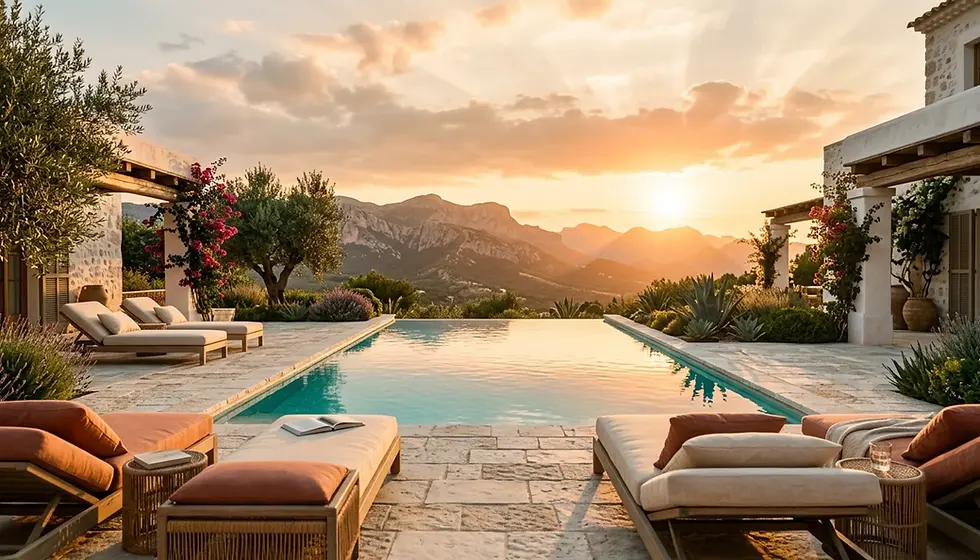
A view-driven or waterfront description example leads with the sensory experience of the view itself before listing room counts or amenities. Industry examples outside our own portfolio illustrate this well: one Caribbean villa description built around a private infinity pool and turquoise sea views markets directly to "discerning travelers who crave both opulence and tranquility," while another notes it's "one of the only villas in the area with a rooftop plunge pool and unobstructed sunset views," emphasizing exclusivity rather than a generic amenity list.
The lesson for a Nashville or Charleston host with a skyline, river, or marsh view: name the specific vantage point (rooftop, private balcony, second-story window) and pair it with a sensory detail (sunset, skyline lights, tidal marsh) rather than simply writing "great view." A description that says "watch the sun set over the Cooper River from your private balcony" outperforms "enjoy the view" because it gives the reader an actual moment to imagine.
Example 7: The Compact City Unit That Sells Convenience
A compact city-unit description example wins by naming exact walking distances and nearby conveniences rather than apologizing for smaller square footage. One widely referenced structure for a small condo lists it as "located just steps from the beach, with coffee on the balcony, ocean breeze, fireplace, fully equipped kitchen, and within walking distance to restaurants, fishing pier, and championship-grade golf courses," stacking specific nouns instead of vague claims of convenience.
For a studio or one-bedroom in downtown Nashville or Charleston's historic district, this same technique applies directly. Name the coffee shop, the honky-tonk row, or the specific market within walking distance. As a result, a guest comparing five similarly sized units will pick the one that feels the most concretely located, even if the unit itself is the smallest of the five.
Where Do DIY Hosts Actually Lose Money on Listing Copy?
DIY vacation rental descriptions typically lose money in three specific, fixable spots: vague distance claims, missing regulatory or safety context, and amenity dumps with no narrative order. Specifically, an owner who writes "close to downtown" instead of "5 minutes to downtown, 7 to Broadway" is giving up a concrete selling point that a guest actively searches for when comparing listings.
First, unquantified distances read as evasive. A guest assumes "close" might mean anything from 5 minutes to 25, and in a market as walkable and Broadway-centric as Nashville, that ambiguity actively costs bookings. Second, amateur descriptions often omit local compliance context entirely, no mention of a rental agreement, ID verification, or security hold process, which creates friction and distrust at the point of booking rather than smoothing it over in advance.
Third, and most commonly, DIY hosts write amenities as an undifferentiated bullet dump: "hot tub, kitchen, WiFi, parking, TV" with no hierarchy. Compare that to the Underwood Manor structure, which opens with the two highest-value features (hot tub, game room) before working down to secondary amenities like the Nespresso machine and record player. Order signals importance. A flat list signals none.
Based on what we see across the Maverick STR portfolio, the properties that command the strongest rate-per-square-foot are rarely the ones with the most amenities. They're the ones whose descriptions explain amenities in a specific order tied to the guest persona, bachelorette groups first want hot tub and game room detail, families first want bedroom configuration and en-suite counts.
How Should a Description Differ Between Airbnb, Vrbo, and a Direct Booking Site?
Vacation rental description length and structure should shift depending on the platform because each interface enforces different reading behavior. Airbnb favors shorter, scannable copy broken into labeled sections (the space, guest access, other things to note), typically staying within 700 to 1000 characters for the primary summary since Hostex's vacation rental description template recommends a 250 to 500 word range for the full listing body.
Vrbo, by contrast, tends to reward slightly longer narrative copy since its interface surfaces more of the description before a guest has to click "read more." A direct booking website you control entirely removes character limits altogether, which means it can and should go deeper: full neighborhood context, specific parking instructions, and a longer story about what makes the stay worth booking outside of an OTA.
This is exactly where a direct booking website earns its keep. Owners who only optimize for Airbnb's compressed format are leaving conversion power on the table when it comes to their own site. If you're building or evaluating a direct booking website, treat the listing description as a completely separate writing exercise from your OTA copy, not a copy-paste job.
Platform | Recommended Length | Structural Priority |
Airbnb | 250-500 words / 700-1000 characters for summary | Labeled sections, scannable bullets, front-loaded USP |
Vrbo | 400-600 words | Narrative flow, more room count and layout detail up front |
Direct booking site | 500-800+ words | Full neighborhood story, parking, local rules, SEO keywords |
What Does a Before-and-After Description Edit Actually Fix?
A before-and-after description edit demonstrates specifically how a vague opening sentence suppresses both search performance and guest conversion, while a rewritten version restores both. Consider a weak opening: "Nice cabin close to the ski slopes with a hot tub, great for families." It states a feature (hot tub) but quantifies nothing and names no landmark.
Now compare a rewritten version modeled after ski-market conventions: "Ski-in access to Jack Frost, 200 yards away. Hot tub on a private deck. Sleeps 8 across 4 king bedrooms. Built for families and groups chasing a Pocono winter getaway." The edit fixes three things at once. It quantifies distance (200 yards, not "close"). It states capacity precisely (8 guests, 4 king bedrooms, not "great for families"). And it names the specific resort, which captures search traffic from guests typing that resort's name directly into Google or Airbnb's search bar.
The revenue impact of this kind of edit is rarely about a single booking. It compounds across a full year of search impressions, longer average length of stay, and a stronger position to hold a higher nightly rate because the listing reads as more curated and higher-effort than a vague competitor two rows down in search results.

Does AI-Assisted Copywriting Help or Hurt Booking Rates?
AI-assisted vacation rental description writing can produce a solid structural first draft, but it consistently underperforms hand-edited copy on the details that actually convert: exact distances, named local landmarks, and property-specific sensory detail. An AI tool asked to "write a description for a 3-bedroom Nashville cabin" will default to safe, generic language, "conveniently located" instead of "5 minutes to downtown," because it has no access to your property's actual GPS coordinates or neighborhood character.
The most effective approach we've seen combines both: use AI to generate a structural first draft (headline, sections, rough amenity groupings), then manually replace every vague phrase with a specific, verifiable detail. For example, prompt an AI tool with a persona-specific brief, "write for a bachelorette party organizer booking for 8 to 10 guests, emphasizing hot tub and nightlife proximity", and then personally verify and insert real distances, real business names near the property, and real capacity numbers before publishing.
Skipping the manual pass is where AI-generated descriptions cause the most damage. A description that overstates a feature (calling a shared driveway "private parking," for instance) creates a guest expectation mismatch that shows up in reviews, not just in the description itself. Reviews then become the long-term cost of a shortcut taken at the writing stage.
Practical Guidance: How to Write or Rewrite Your Own Description
Follow this sequence when writing or auditing a vacation rental description, whether you're starting from scratch or fixing an underperforming listing that's been live for years.
Write your headline last. Draft the full description first, then extract the single strongest sentence as your opening hook. Use the formula: adjective plus property type plus top feature plus distance to a named landmark.
Quantify every distance claim. Replace "close to," "near," and "minutes away" with an actual number. "5 minutes to downtown" beats "close to downtown" in every version we've tested across managed listings.
Group amenities by guest persona, not by room. A bachelorette-focused property should lead with hot tub, game room, and nightlife proximity before mentioning the dishwasher. A family property should lead with bedroom configuration and safety features.
Name specific materials, colors, and objects. "Velvet barstools" and "rustic wood floors" outperform "stylish decor" because they're visualizable.
Address logistics before a guest has to ask. Parking instructions, check-in process, and any local compliance requirements (rental agreements, ID verification, security holds) should appear in the description, not just in a post-booking message.
Match length to platform. Trim for Airbnb's compressed interface, expand for Vrbo and your own direct booking site.
Read it out loud as a guest, not an owner. Owners tend to over-describe features they're proud of (a renovation, a specific appliance brand) and under-describe what a guest actually cares about: how far is it, how many can sleep here, and what does the day actually look like.
Common mistakes to avoid: burying your strongest feature past the first sentence, using more than two generic adjectives in a row, listing amenities without grouping, and omitting parking or check-in logistics entirely. Estimated time for a full rewrite of a single listing: 2 to 4 hours if done properly, factoring in research on nearby landmarks and photography cross-reference.
How Do Professional Descriptions Affect Pricing Power and Direct Bookings?
Professional vacation rental copywriting directly affects three revenue levers: achievable nightly rate, average length of stay, and the ratio of direct bookings to OTA-sourced bookings. A description that reads as curated and specific signals to a guest that the property itself is likely to be equally well-maintained, which supports a higher price point without a corresponding drop in occupancy.
Specifically, a stronger description also tends to attract a better-fit guest, which reduces mismatched expectations and, as a result, reduces negative reviews tied to "not as described" complaints. This matters more in 2026 than it once did, since AirDNA market data shows Nashville's median occupancy sitting at 44% while the top 10% of best-in-class properties achieve 78% or higher, a gap that's driven as much by listing quality and pricing strategy as by the physical property itself.
One of our owners came to Maverick STR with a property projected to generate $60,000 in its first year based on a generic self-written listing. After a full rewrite of the description alongside pricing and channel strategy, that same property closed its first year at $100,000, a direct result of combining stronger copy with active revenue management rather than either lever alone.
Direct booking sites benefit even more from strong copywriting because there's no OTA algorithm doing any of the selling for you. If you're weighing whether your own site needs a content overhaul, our vacation rental SEO resources go deeper into how listing copy and search visibility work together, and our complete SEO playbook for Nashville and Charleston hosts covers the technical side of getting that copy found in the first place.
Data & Evidence: What the Numbers Say About Listing Quality
Verified market data reinforces why description quality is a revenue issue, not just a cosmetic one. Nashville's average nightly Airbnb rate sits at $360 with a RevPAR of $156, according to AirROI's 2026 market data, across roughly 2,843 active listings competing for the same guest pool. With that much inventory to sort through, a description that fails to differentiate in the first two sentences simply gets scrolled past.
Nationally, the property management industry itself reflects the scale of this competition: IBISWorld estimates the U.S. property management sector at $139.9 billion in 2026, spread across roughly 340,000 businesses. For an individual owner, that means your listing isn't just competing with the house next door, it's competing in a market where professional operators are actively optimizing every sentence of their copy.
The takeaway isn't that every owner needs to hire a copywriter tomorrow. It's that treating the description as a one-time task, written once at listing setup and never revisited, leaves real money on the table in a market moving this fast.
Frequently Asked Questions
How long should a vacation rental description be?
Most vacation rental descriptions perform best between 250 and 500 words for the core copy, with Airbnb summaries staying closer to 700 to 1000 characters for mobile readability. Direct booking websites can run longer, often 500 to 800 words, since there's no platform-imposed character limit.
What's the biggest mistake owners make writing their own listing description?
The most common mistake is using vague adjectives like "nice" or "close by" instead of specific, quantifiable details. A description that says "5 minutes to downtown" with named amenities converts better than one that says "conveniently located near everything."
Should I use AI to write my vacation rental description?
AI tools work well for generating a structural first draft, headline format and section organization, but they default to generic language without property-specific detail. Always follow an AI draft with a manual pass that adds real distances, specific materials, and verified local landmarks.
Does a better description actually increase my nightly rate?
Yes, in practice, stronger listing copy supports higher achievable rates because it signals a well-managed, curated property and attracts better-fit guests. One property in the Maverick STR portfolio grew from a $60,000 first-year projection to $100,000 in actual revenue after a description rewrite paired with active pricing strategy.
Should my Airbnb description be different from my direct booking website description?
Yes. Airbnb rewards shorter, scannable copy broken into labeled sections, while a direct booking website you control can go significantly deeper into neighborhood context, parking details, and SEO-focused language without any character limit constraints.
What should the first sentence of a vacation rental description say?
The first sentence should carry your single strongest, most quantifiable selling point, whether that's a hot tub capacity, a specific distance to a landmark, or a guest capacity number, since many readers only scan the opening line before deciding whether to keep reading.
Do I need to mention local rules or compliance requirements in my description?
Yes, briefly. Mentioning a rental agreement, ID verification step, or security hold process upfront reduces booking friction and guest confusion, rather than surprising a guest with those requirements only after they've already paid.
Conclusion
The seven vacation rental description examples above share one underlying rule: specificity sells, vagueness doesn't. Whether it's Underwood Manor's front-loaded hot tub capacity, The Herman Haven's en-suite-per-bedroom detail, or a ski cabin's 200-yard distance callout, every high-performing description replaces a generic claim with a verifiable, visualizable detail.
Amateur hosts lose money in predictable places: unquantified distances, missing compliance context, and undifferentiated amenity lists. Fixing those three issues alone, without touching pricing or photography, is often enough to shift a listing from overlooked to booked. As 2026 market data confirms, Nashville's gap between median and top-tier occupancy is wide, and listing copy is one of the most controllable levers an owner has to close that gap.
If rewriting your own listing description feels like one more task on an already full plate, Maverick STR handles listing optimization as part of a broader marketing and revenue strategy, with clients across our managed portfolio consistently outperforming their local market by 50% or more. Get started with Maverick STR for a free review of your current listing copy and pricing strategy.

Written by Chase Gillmore, Owner & Operator at Maverick STR
Content powered by inkSTR.co


Comments