

Property Manager Cost in South Carolina: 2026 Guide


short-term rental property manager typically charges between 15% and 25% of gross rental revenue
STR managers in South Carolina charge 15-25% of gross revenue, with full-service premium operators reaching up to 30%.
Charleston averaged $225.10 ADR and 64% occupancy in 2026, according to AirDNA market data.
Expect separate one-time and recurring fees beyond the monthly percentage, including placement, lease renewal, and maintenance coordination.
South Carolina imposes a statewide 6% sales tax on short-term lodging, plus local accommodations taxes that can push the combined rate above 12%.
At Maverick STR, we have helped Charleston property owners reach the 90th percentile in their market. The right management fee earns more than it costs.
The smartest evaluation is not "what is the fee?" but "what does the fee return?" A manager who commands 22% and outperforms market RevPAR by 30% is cheaper than one charging 15% who leaves revenue on the table.
How Much Does a Property Manager Cost in South Carolina?
A property manager in South Carolina costs between 15% and 25% of gross rental revenue for short-term vacation rentals, and between 8% and 12% of monthly collected rent for long-term residential properties. The specific rate depends on property type, location, service tier, and whether the manager handles full operations or only selected functions. In 2026, the Charleston market sits toward the higher end of this range because of strong tourism demand, regulatory complexity, and the operational intensity of managing a property that welcomes seven million annual visitors to the region.
To put the numbers in practical terms: a Charleston short-term rental generating $32,100 in average annual revenue (the AirDNA 2026 market figure for the area) at a 20% management fee means roughly $6,420 per year in management costs. At 25%, that rises to $8,025. Neither figure includes cleaning fees, maintenance reserves, or the statewide accommodations tax obligations the manager may handle on your behalf.
Long-term rental managers in Charleston typically charge 8-12% of monthly rent. With an average Charleston rent of $1,889 per month as of June 2026 (per Apartments.com data), an 8% management fee works out to about $151 per month or roughly $1,815 annually. That is a fundamentally different cost structure than STR management, and the two should not be compared directly.

What Is the Typical Management Fee for a Vacation Rental in SC?
The typical management fee for a South Carolina vacation rental in 2026 is 18-22% of gross revenue for a standard full-service arrangement. This range covers guest communication, booking management, dynamic pricing, cleaning coordination, and basic maintenance oversight. Operators offering premium tiers, including 24/7 concierge, in-person property inspections after every stay, and professional marketing, routinely charge 25-30%.
What Is Included in a South Carolina STR Management Fee?
A standard South Carolina STR management fee includes a defined set of operational services, but what exactly falls inside that percentage varies significantly between companies. The best operators include dynamic pricing and revenue management, listing optimization across Airbnb and VRBO, guest communication and vetting, cleaning scheduling and quality control, and basic maintenance coordination. Lower-fee operators may include only booking management, leaving revenue strategy and maintenance entirely in your hands.
Specifically, here is what a 20-25% full-service arrangement should cover:
Dynamic pricing updates using tools like PriceLabs or Wheelhouse, adjusted for local demand signals
Listing management on multiple OTA platforms, including photo sequencing and description optimization
24/7 or business-hours guest messaging and issue resolution
Cleaning team coordination and turnover scheduling between stays
Monthly revenue reporting and owner disbursement
Accommodations tax remittance to the South Carolina Department of Revenue and Charleston County
Coordination of routine maintenance and emergency repairs (typically as a pass-through cost, not included in the fee)
What the fee usually does not cover: actual cleaning labor costs (billed separately per turn), maintenance parts and contractor labor, deep cleaning or post-damage restoration, and professional photography at onboarding.
Full-Service vs. Co-Hosting: How Do the Fees Differ?
Full-service management and co-hosting are two distinct service models with materially different fee structures. Full-service management means the manager handles all operations independently. Co-hosting means the manager handles specific tasks, typically guest communication and cleaning coordination, while the owner retains control over pricing, calendar management, and major decisions. Co-hosting fees in South Carolina commonly run 10-15% of gross revenue because the scope is narrower.
The right choice depends on how involved you want to be. If you live out of state or want completely passive income, full-service management at 20-25% is the appropriate model. If you are a local owner who wants help with guest messaging but prefers to control your own pricing, co-hosting at 10-15% may suit you better. For a deeper look at how these two models compare in the Charleston market specifically, the article on Airbnb co-hosting vs. full-service management in Charleston walks through the trade-offs in detail.
What Is a Reasonable Management Fee for a South Carolina Rental?
A reasonable management fee for a South Carolina short-term rental is one that aligns with the services delivered and produces net revenue above what you could achieve self-managing. The fee percentage alone is not the right benchmark. A manager charging 20% who delivers consistent 90th-percentile RevPAR through professional revenue management is dramatically more valuable than one charging 15% who uses a static pricing calendar and leaves peak-demand dates underpriced.
Industry practice in Charleston puts the reasonable range at 15-25% for STR management and 8-12% for long-term residential properties. At the lower end of the STR range, expect lighter-touch services with less proactive revenue optimization. At the upper end, you should see active market analysis, event-based pricing adjustments (Charleston hosts a significant volume of destination weddings, festivals, and conference events throughout the year), and 24/7 guest support with local response capability.
Portfolio discounts are a real and negotiable factor. Charleston property managers commonly offer 1-2% off their base rate when managing three or more properties for the same owner. If you own multiple units in the area, that discount is worth asking about explicitly before signing any contract.
How Market Conditions Affect What You Pay in 2026
The Charleston STR market in 2026 is showing signs of measured correction after several years of rapid growth. According to AirDNA data, occupancy has declined roughly 5% year-over-year, while revenue per available rental (RevPAR) sits at $134.40 for the area. The market still outperforms most South Carolina destinations, supported by approximately seven million annual visitors, but it is more competitive than it was in 2022-2023.
This shift has a direct effect on management fees in practice. As occupancy softens, the gap between operators who use dynamic pricing and those who do not widens. A property managed with active yield management and demand-signal pricing can maintain strong RevPAR even in a slightly softer market. One managed passively with flat or seasonally adjusted rates will feel the full effect of that 5% occupancy decline. The value of the management fee is highest precisely when the market gets harder, not easier.
Short-term rental operators in Charleston are increasingly adopting dynamic pricing tools to offset declining occupancy and protect RevPAR. If your manager is not actively adjusting rates based on real-time demand data, that is a service gap worth addressing, regardless of what fee percentage they charge.

Do You Need a License to Be a Property Manager in SC?
Yes, property managers in South Carolina are required to hold a real estate license to legally manage properties on behalf of others for compensation. Specifically, South Carolina law requires anyone acting as a property manager for compensation to pass the property management exam and apply for either a property manager license or a property manager in charge license within one year of passing. The exam fee is $63, and the license must be maintained through continuing education requirements.
This licensing requirement applies to property management companies collecting fees to manage properties on behalf of third-party owners. It is a meaningful compliance signal when evaluating management companies in the Charleston area. A licensed property manager in charge has met South Carolina's professional standards; an unlicensed operator managing properties for compensation is operating outside state law.
For short-term rental operators, there is an additional layer of local compliance. The City of Charleston requires all STR operators to obtain a Short Term Rental Occasional Lodging License, which must be renewed annually and posted in the rental unit. The city also mandates that all booking platform listings display the city-issued registration number. A professional property manager should handle both the state licensing requirements on their end and guide you through your property's local registration obligations.
Beyond licensing, Charleston's STR ordinance caps short-term rentals in certain residential zones at a maximum of four bedrooms and prohibits STRs entirely in some districts unless specifically permitted by local overlay. Confirming your property's zoning eligibility before signing a management contract is essential, and a competent local manager should be able to confirm this for you immediately.
Is a Property Manager a Good Idea for Charleston STR Owners?
For most Charleston short-term rental owners, hiring a property manager is a good idea when the combination of time savings and revenue uplift exceeds the management fee cost. The calculation changes significantly based on whether you live locally or out of state, how many properties you manage, and whether you currently use dynamic pricing and active listing optimization.
Self-managing a Charleston STR is not simply answering guest messages. It involves daily pricing decisions, cleaning team coordination between stays, compliance with city licensing requirements, accommodations tax collection and remittance to the South Carolina Department of Revenue, and 24/7 availability for guest issues. Most owners who track their hours honestly find they are spending 10-20 hours per week on a single property that was supposed to be passive income.
The revenue argument is also compelling. At Maverick STR, our team regularly works with property owners whose listings were underperforming the market through static pricing and inconsistent guest experiences. One Charleston-area client had a property projected to generate $60,000 in its first year. With professional management, active revenue strategy, and listing optimization, that same property generated $100,000. The management fee was a fraction of that additional $40,000 in revenue.
For out-of-state owners specifically, the question is not whether to hire a manager but which manager to trust. You cannot physically respond to a maintenance emergency, coordinate a same-day cleaning, or verify that your property meets the city's annual license renewal requirements from another state. Local, professional management is not optional for this group; it is the infrastructure that makes remote property ownership viable. The article on Charleston SC property management covers the full operational picture for owners in this position.
The Hidden Costs That Change the Real Fee Calculation
The management fee percentage is the headline number, but it is rarely the whole story. Several additional costs routinely appear in South Carolina property management contracts, and understanding them before you sign is the difference between a fee structure that makes sense and one that erodes your margins unexpectedly.
Here are the costs that most property owners underestimate or overlook entirely:
Fee Type | Typical Range (SC / Charleston) | Notes |
Monthly management percentage (STR) | 15-25% of gross revenue | Core fee; covers operations and guest management |
Monthly management percentage (LTR) | 8-12% of collected monthly rent | Lower rate reflects less operational intensity |
Tenant/guest placement fee (LTR) | 50-100% of first month's rent (one-time) | Charged at move-in; covers screening and lease prep |
Lease renewal fee (LTR) | Flat fee or reduced percentage | Varies; often $100-300 per renewal |
Cleaning fee (STR) | 5-10% of revenue budget, or per-turn billing | Usually passed through to owner separately |
Maintenance coordination fee | 5-15% of maintenance invoice | Some companies include this; many charge separately |
Professional photography (onboarding) | 3-5% of revenue budget, or flat $200-500 | One-time cost; critical for listing conversion |
State accommodations tax (SC) | 6% statewide + local tax (combined can exceed 12%) | Collected from guests, remitted to SCDOR; manager may handle for a fee |
City STR license renewal (Charleston) | Annual; confirm current fee with City of Charleston | Required annually; manager may handle or advise |
The accommodations tax obligation deserves particular attention. South Carolina imposes a 6% statewide sales tax on short-term lodging, and Charleston County adds local accommodations taxes on top of that. Combined, the tax burden on a Charleston STR can exceed 12% of rental revenue. This does not come out of the management fee; it comes out of the guest's payment (or your gross revenue if not properly structured). A property manager who handles tax remittance on your behalf through the South Carolina Department of Revenue is providing a meaningful compliance service, not just a bookkeeping convenience.
For a broader comparison of how management fee structures differ between large national operators and local Charleston companies, the piece on big management companies vs. local Charleston property management examines why many owners are moving away from large franchise operators toward specialized local teams.
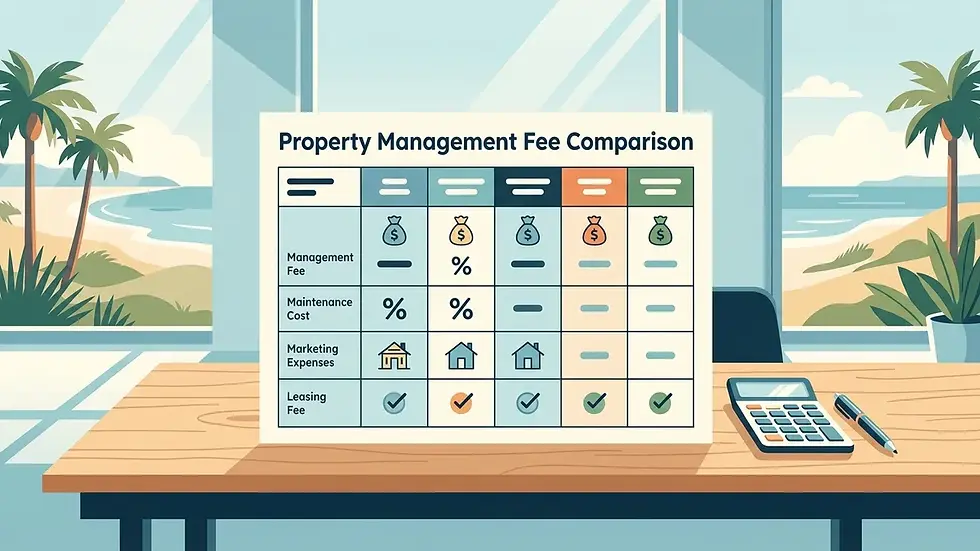
How to Compare Property Management Companies in South Carolina
Comparing property management companies in South Carolina requires evaluating five dimensions beyond the headline fee: service scope, revenue performance track record, local market knowledge, technology and pricing tools used, and contract terms including cancellation provisions.
Start with service scope. Request a written list of what is and is not included in the management fee before any conversation about percentage. Two companies can both charge 20%, and one includes dynamic pricing, listing optimization, and tax remittance while the other covers only booking management and guest messaging. Those are not comparable offers at the same price.
Revenue performance is the most important dimension and the hardest to verify. Ask for the average RevPAR of managed properties compared to the local market benchmark. Ask specifically whether properties are performing above or below the AirDNA market average for the Charleston area. A manager who cannot answer this question with specific numbers does not have a performance-driven approach, which means their fee is not tied to your outcomes.
Local market knowledge matters in a market as regulation-heavy and event-driven as Charleston. The city's STR ordinance, the seasonal tourism calendar, the effect of events like the Spoleto Festival USA and SEWE (Southeastern Wildlife Exposition) on demand, and the neighborhood-level zoning variations all affect revenue. A manager who has operated multiple properties in Charleston for several years will price around these windows effectively. A national franchise operating through a local franchisee may apply generic algorithms that miss them entirely.
On contract terms: look for month-to-month arrangements or reasonable termination windows (60-90 days written notice is standard). Avoid long-term lock-in contracts without a performance-based exit clause. If a management company is confident in their results, they should not need to trap you contractually. You can also explore how STR revenue management fits into the broader management picture when evaluating a company's pricing capabilities.
Finally, verify licensing. Ask directly whether the management company holds a South Carolina property manager or property manager in charge license as required by state law. A legitimate operator will answer this immediately and offer to provide their license number.
Frequently Asked Questions
What is the average property management fee in South Carolina in 2026?
The average property management fee for a short-term vacation rental in South Carolina in 2026 is 15-25% of gross rental revenue. For long-term residential properties, the standard range is 8-12% of monthly collected rent. Premium full-service operators in Charleston, particularly those offering concierge-level guest services and active revenue management, may charge up to 30% for high-demand properties. The fee you pay should reflect the full scope of services delivered, not just the percentage itself.
Do you need a license to be a property manager in SC?
Yes. South Carolina law requires property managers who manage properties on behalf of others for compensation to hold a valid real estate license, specifically a property manager or property manager in charge license. Candidates must pass the state property management exam (fee is $63) and apply for licensure within one year of passing. Operating as a compensated property manager without this license violates South Carolina law, so verifying your manager's licensure status is a basic due diligence step.
Is a property manager worth it for a Charleston short-term rental?
For most Charleston STR owners, a property manager is worth the fee when the revenue uplift from professional pricing and optimization exceeds the management cost. Charleston's market complexity, including city licensing requirements, accommodations tax obligations, and the need for active dynamic pricing, makes professional management particularly valuable. Owners who self-manage while living out of state consistently report that they are under-earning relative to managed properties in the same neighborhood, and the liability exposure of remote self-management adds risk that the fee hedges effectively.
What is a reasonable management fee for a vacation rental?
A reasonable management fee for a vacation rental is one tied to clear deliverables and measurable performance outcomes, not just a percentage of revenue. In South Carolina's STR market, 15-22% is reasonable for standard full-service management. Fees above 22% should be justified by demonstrated revenue outperformance, premium services like 24/7 guest concierge, or specialized local market expertise. The worst management arrangement is a low fee from a company that fails to optimize pricing and occupancy, because you pay both the fee and the lost revenue.
What taxes do I owe on a South Carolina short-term rental?
South Carolina imposes a statewide 6% sales tax on short-term lodging revenue. Charleston County adds local accommodations taxes on top of the state rate, which can push the combined tax obligation above 12% of rental revenue. Property owners must collect these taxes from guests and remit them to the South Carolina Department of Revenue, either directly or through their booking platform or property manager. Failure to remit properly creates liability with the SCDOR, which many professional managers handle on the owner's behalf as part of a full-service arrangement.
Are there additional fees beyond the monthly management percentage in South Carolina?
Yes, and they are significant. Common additional fees include a one-time tenant placement fee of 50-100% of first month's rent for long-term rentals, a lease renewal fee for extended tenancies, per-turn cleaning fees billed as a pass-through, a maintenance coordination markup (typically 5-15% of the contractor invoice), and professional photography costs at onboarding. Some companies include tax remittance in their fee structure; others bill it as an administrative service. Always request a full written fee schedule before signing a management agreement.
What is the Charleston STR market RevPAR in 2026?
According to AirDNA 2026 market data, the Charleston short-term rental market has a revenue per available rental (RevPAR) of $134.40, an average daily rate of $225.10, and an occupancy rate of approximately 64%. The market has experienced roughly a 5% year-over-year decline in occupancy compared to the prior year, indicating a more competitive environment where active revenue management and listing quality make a measurable difference in individual property performance relative to the market average.
How do I find a reputable STR property manager in Charleston, SC?
Start by verifying that any property manager holds a valid South Carolina property manager license. Then request a written service scope and full fee schedule, ask for average RevPAR performance across their managed portfolio compared to the Charleston market benchmark, and check for recent client reviews on Google or third-party platforms. Local operators with hands-on Charleston market experience, active dynamic pricing tools, and direct relationships with cleaning and maintenance vendors will consistently outperform national franchise operators who rely on algorithmic management without local oversight.
What Should You Do Next?
Property manager cost in South Carolina is not a single number. It is a range that spans 15-30% of gross revenue for short-term rentals depending on service depth, operator quality, and market positioning. The Charleston STR market in 2026 rewards owners who invest in professional pricing and compliance support, with AirDNA data showing average annual revenues around $32,100 per listing at a $225.10 ADR. The right management fee, paid to the right operator, is not an expense. It is the cost of accessing revenue performance you cannot generate alone.
Start by getting written fee schedules from at least three local operators. Compare service scope line by line, not just percentage. Verify licensing. Ask for performance data against the Charleston market benchmark. And factor in the full cost picture, including accommodations taxes, cleaning fees, and maintenance coordination, before deciding which fee structure actually serves your investment goals.

If you are a Charleston property owner evaluating your management options or a first-time host trying to understand what professional management actually looks like in practice, Maverick STR manages and markets vacation rental properties in Charleston with a track record of landing properties in the 90th percentile of their market. We took one property projected at $60,000 in year one and delivered $100,000. That result does not happen with passive management and a static pricing calendar. It happens with a structured revenue strategy, professional listing optimization, and local market knowledge that national operators simply do not have.
Property owners who want to explore what that management approach looks like for their specific property can start the conversation at Maverick STR.


Comments