

Off-Season Marketing and Pricing Tactics for Charleston STR Owners


Off-season marketing and pricing tactics refer to the deliberate strategies short-term rental owners use to maintain bookings and protect revenue during periods of naturally lower traveler demand. In Charleston, SC, those tactics look fundamentally different from what works in harsher climates, and that difference is the competitive edge most hosts are leaving on the table in 2026.
Charleston's STR market averages $58,600 in annual revenue per listing, with a 65% occupancy rate year-over-year, according to AirDNA: but that average masks wide performance gaps between hosts who actively manage off-season and those who coast.
Charleston's mild winters create a genuine off-season opportunity that most northern markets cannot replicate: January lows average in the upper 40s Fahrenheit, making the city walkable and attractive to remote workers and retirees when beach destinations elsewhere are frozen.
Discount depth matters more than discount presence: bundled packages consistently outperform straight percentage-off pricing because of how guests perceive value relative to the reference price.
Charleston's 2026 event calendar is unusually dense, including the 50th anniversary Spoleto Festival, the Cooper River Bridge Run, and the city's designation as one of four U.S. Congress "signature cities" for America's 250th anniversary, all of which create demand spikes hosts can plan around months in advance.
Over-discounting is a real brand risk: aggressive rate cuts during slow periods can signal low quality to prospective guests and erode the pricing authority you need to command premium rates during peak season.
The most effective off-season strategy is layered: pricing adjustments plus targeted digital marketing plus experience packaging, executed together, not separately.
Why Does Charleston's Off-Season Differ From Other STR Markets?
Charleston's off-season refers to the period roughly between mid-November and late February when leisure travel volume softens, but the city's mild climate means that softening is shallower than in most comparable U.S. markets. According to the AirDNA market overview, Charleston's Seasonality score is 70 out of 100, indicating moderate variability rather than the dramatic winter cliff that affects beach markets in the Carolinas further north.
Specifically, Charleston's tourism industry generated a $14 billion economic impact in May 2026, according to the College of Charleston Office of Tourism Analysis, with tourism accounting for 23.5% of all regional sales. That base of economic activity does not simply vanish in January. What shifts is the traveler profile.
Off-season visitors to Charleston skew toward remote workers, Baby Boomers, and experience-driven travelers seeking culinary tourism, historic architecture tours along Rainbow Row and the Battery, and outdoor pursuits in the ACE Basin. These guests are not chasing beach weather. They are chasing a slower, more intimate version of Charleston that peak-season crowds make difficult. Additionally, 38.4% of active Charleston STR listings require minimum stays of 30-plus nights, reflecting how much medium-term stay demand the market carries year-round. That segment, extended stays from corporate travelers and remote workers, barely fluctuates seasonally.
At Maverick STR, we advise Charleston property owners to think about off-season not as a period to survive but as a segment of the market with a genuinely different buyer. The pricing strategy, the marketing channel, and the guest experience you emphasize in January should be deliberately tailored to that buyer, not simply a discounted version of what you offer in June.

What Is a Seasonal Pricing Strategy for Short-Term Rentals?
A seasonal pricing strategy is a systematic approach to adjusting nightly rates based on predictable shifts in traveler demand across different periods of the year. For short-term rental operators, seasonal pricing goes beyond simply raising rates in summer and dropping them in winter. The most effective version involves mapping demand at the weekly level and aligning pricing decisions to specific demand drivers rather than broad seasonal labels.
Charleston's STR average daily rate is $399 as of the most recent AirDNA data, up 3% year-over-year. But that figure is a market average across all 3,405 active listings. Within that average, properties near the French Quarter and historic Charleston peninsula command dramatically different rates in January versus July, while properties in West Ashley or James Island show a more compressed seasonal range because their demand base includes more local extended-stay guests year-round.
A functioning seasonal pricing strategy for Charleston STRs should include four components. First, a baseline rate calibrated to your property's actual competitive set, not the broad market average. Second, a premium rate schedule tied to specific confirmed demand events: the Cooper River Bridge Run in early spring, the Credit One Charleston Open in February, the Spoleto Festival, and the SEWE (Southeastern Wildlife Exposition) in February 2026. Third, an off-season floor rate that protects brand positioning without surrendering occupancy entirely. Fourth, a dynamic pricing tool running in the background, configured by someone who understands the Charleston market, not left on default settings.
For a deeper look at how revenue management frameworks apply across STR markets, the five keys to STR revenue management are worth reviewing alongside this seasonal approach.
What Are the 5 C's of Pricing for Vacation Rentals?
The 5 C's of pricing refer to five foundational factors that determine whether a price will convert: Cost, Competition, Customer, Channel, and Conditions. Applied to vacation rental off-season pricing in Charleston, each C provides a specific decision anchor that prevents the two most common mistakes: discounting too little (staying empty) or discounting too much (attracting the wrong guests and damaging brand equity).
Cost establishes your floor. Your mortgage, cleaning fees, utilities, and platform commissions define the minimum rate below which you are literally losing money on each booking. Know this number precisely before setting any promotional rate.
Competition tells you where your rate sits in the market. Pull your competitive set weekly in January and February. In Charleston's off-season, many hosts drop rates reactively, creating temporary price compression that passes within weeks. Staying slightly above the floor of your comp set, rather than at the bottom, often produces better occupancy outcomes because guests associate price with quality.
Customer in the off-season means understanding that your January guest and your July guest are different people with different willingness to pay. The remote worker booking a 14-night stay cares more about fast WiFi and a dedicated workspace than a discounted nightly rate. Price accordingly.
Channel refers to where the booking originates. Airbnb and VRBO both take platform fees that compress your net revenue. Off-season is an ideal time to push direct booking traffic, where you capture the full nightly rate without commission. Your direct booking website should carry promotional off-season packages that are not available on the OTAs, giving past guests a concrete reason to book direct.
Conditions covers macro factors: Charleston's 2026 designation as an America250 signature city will drive incremental national and international tourism throughout the year, including traditionally slow months. Condition-aware pricing means building upward pressure into your Q1 rates based on this known demand driver, not treating January 2026 like January 2026.
What Is the 3-3-3 Rule in Marketing and How Does It Apply Off-Season?
The 3-3-3 rule in marketing refers to a content and audience engagement principle: target three different audience segments, with three different messages, across three different channels, to maximize reach without cannibalizing your core messaging. For short-term rental operators in Charleston applying off-season marketing and pricing tactics, this rule provides a practical structure for avoiding the single most common off-season marketing mistake: blasting one generic discount offer at everyone and wondering why it underperforms.
Applied specifically to a Charleston STR operation in the off-season, your three audiences are distinct. First, past guests who already know and trust your property. Second, new-to-Charleston travelers researching the city for a winter or early spring visit. Third, local or regional travelers, the drive market within three to four hours, who might not have considered Charleston in January but respond to a well-framed itinerary.
Your three messages should differ by audience. Past guests respond to loyalty framing: exclusive rates for returning guests, early access to spring availability, or a referral incentive. New travelers respond to destination framing: why Charleston in winter is a better experience than Charleston in summer, with specific examples like uncrowded access to the City Market, shorter waits at sought-after restaurants in the French Quarter, and walkable historic tours without August humidity. Regional drive-market guests respond to value framing: a two-night package that includes a curated restaurant guide and a flexible check-in time costs you almost nothing to offer but meaningfully increases perceived value.
Your three channels in 2026 should be email, paid social retargeting, and SEO-optimized content. Email marketing is consistently the highest-ROI channel for direct bookings during off-season because you are reaching people who have already expressed interest in your property. One targeted email per month during the off-season, focused on a specific upcoming Charleston event or experience, will outperform any volume of generic social media posting.

What Are the 4 P's of Pricing Strategy for STR Off-Season Revenue?
The 4 P's of pricing strategy refer to Price, Product, Promotion, and Placement, the four levers a short-term rental operator controls when trying to optimize revenue during slow demand periods. Unlike seasonal demand, which you cannot control, all four P's are within your direct influence and can be adjusted specifically for the Charleston off-season without waiting for market conditions to improve.
Price: Set a Floor, Not a Race to the Bottom
The most damaging off-season pricing move you can make is setting your rates based on what the cheapest listing in your comp set is charging. Charleston's STR market carries a RevPAR of $258.20, up 6% year-over-year according to AirDNA. That RevPAR growth in an 8% listing-growth environment tells you that better-managed properties are maintaining pricing power even as supply expands. Your off-season floor should be set at the rate that produces a profitable booking without signaling desperation to prospective guests. For most Charleston entire-home listings, that means staying above $150 per night even in January, unless your property is in a peripheral location where the rate-to-demand relationship behaves differently.
Product: Reframe What You Are Selling
In summer, you are selling beach proximity, outdoor space, and group entertainment. In winter, you are selling a different product entirely: privacy, walkability to historic Charleston, a fireplace or cozy interior, a workspace setup for the remote professional. Update your listing photos, your title, and your description for the off-season to lead with what January guests actually want. Platforms like Airbnb and VRBO reward listings that match guest search intent, and winter guests search differently than summer guests.
Promotion: Bundles Beat Discounts
No competitor currently covers this distinction with any depth, so here is the practical reality: a straight 20% price cut signals to a prospective guest that your property was overpriced before, or that it is somehow less desirable now. A bundled package at the same effective price, for example, two nights plus a curated Charleston restaurant guide, a flexible late checkout, and a local grocery pre-stock, signals generosity and thoughtfulness without triggering the anchoring effect of seeing a slashed rate. The guest perceives added value rather than reduced quality. This is why resort markets that slash prices during cold snaps consistently see lower booking quality, higher cancellation rates, and lower review scores than those same properties when they reframe the same economic offer as a curated experience package.
Placement: Push Direct, Pull Organic
Off-season is the right time to invest in your organic and direct booking channels because the cost of acquiring that traffic is lower and the payoff extends into peak season. A piece of SEO-optimized content about Charleston off-season experiences, published in October, can rank and generate direct booking inquiries through February and March. The vacation rental SEO strategies that drive year-round organic traffic pay their biggest dividends precisely when OTA algorithm competition is fiercest and platform fees bite hardest.
How Should You Avoid Over-Discounting and Protecting Brand Equity?
Over-discounting in off-season STR pricing refers to the practice of cutting nightly rates so aggressively that the short-term occupancy gain is offset by long-term damage to your property's perceived value and your ability to command premium rates when demand returns. This is the content gap every major competitor in this space ignores, and it is arguably the most costly mistake Charleston STR owners make between November and February.
The psychology is well-documented in pricing research: consumers use price as a quality signal, particularly for unfamiliar purchases. A traveler choosing between two Charleston properties they have never stayed at will often interpret the lower-priced option as lower quality, not better value. Specifically, when your January rate is 40% below your peak-season rate, you are not just attracting bargain hunters; you are actively filtering out the higher-value guests who would have booked at a 15% reduction and left you a better review.
The practical threshold most experienced operators use is a maximum seasonal discount of 15-25% off peak rates for comparable night types, weeknight versus weekend, holding that floor even if dates go unbooked in the final two weeks before arrival. Flash sales, defined as 24 to 48-hour promotions to your existing email list or past guest database, can push below that floor temporarily without the brand damage that a permanently low listing rate causes, because the guest receives a clear signal that the low price is an exception, not the property's true value.
This is exactly the kind of nuanced revenue calibration that the Maverick STR revenue management team works through with Charleston property owners. The goal is never maximum occupancy. The goal is maximum revenue per available night, which sometimes means letting a date stay open rather than booking it at a rate that sets the wrong anchor for future guests.
For a broader view of how this philosophy connects to a full revenue management framework, the STR revenue management principles we apply across our managed portfolio offer additional context. And if you want to understand how Nashville's hybrid pricing model compares to Charleston's seasonal approach, the pillar article on STR revenue management and Nashville's hybrid model goes deeper on the structural differences between those two high-performing markets.
Off-Season Digital Advertising: Where to Spend When Competition Is Low
Off-season digital advertising for short-term rentals refers to the deliberate deployment of paid media during low-demand periods, specifically timed to capitalize on lower cost-per-click rates and reduced advertiser competition. This is a content gap that no competing article addresses, and it represents a meaningful asymmetric opportunity for Charleston STR owners who are willing to spend modestly when most competitors have gone quiet.
In digital advertising, January and February are historically low-CPC months for travel and hospitality keywords because most large operators pull back budgets after the holiday season. That means your Google Ads cost per click for Charleston vacation rental queries may be 30-50% lower in January than in June, for the same search terms. Running a modestly budgeted Google campaign targeting "Charleston SC February getaway" or "Charleston winter vacation rental" during those months costs less per click and faces less competition from professional advertisers than it will at any other point in the year.
Meta retargeting is the other channel worth activating in the off-season. Past website visitors who looked at your property in October but did not book are warm leads. A retargeting campaign on Facebook or Instagram, showing those specific visitors your winter package offer with a bundled experience frame, converts at meaningfully higher rates than cold audience campaigns because the trust barrier has already been partially crossed. The cost to serve those retargeting ads is low because your retargeting audience is small and defined.
Budget guidance: most individual property owners see meaningful results from a combined off-season paid media budget of $300 to $600 per month across Google and Meta, with the majority allocated to retargeting rather than cold prospecting. Spend more only if your direct booking analytics show strong landing page conversion rates. Sending paid traffic to a weak direct booking website is the fastest way to burn that budget with nothing to show for it.

Charleston's 2026 Event Calendar: Your Off-Season Pricing Roadmap
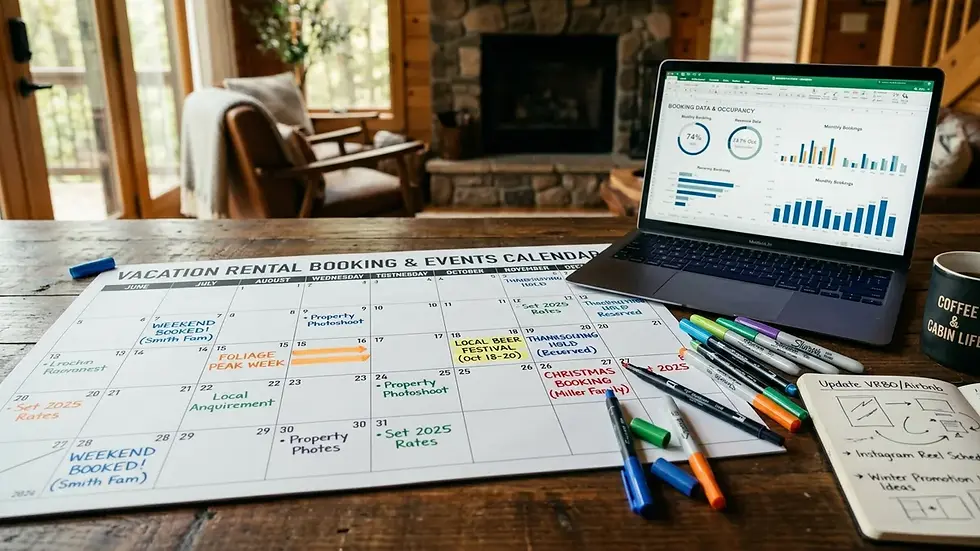
Charleston's 2026 event calendar is one of the most demand-rich in the city's recent history, and it directly shapes which months actually qualify as "off-season" for revenue-aware STR operators. Several events that typically anchor shoulder-season demand are scaled up significantly this year.
Event | Approximate Timing | Demand Impact | Pricing Action |
Southeastern Wildlife Exposition (SEWE) | February 2026 | High: regional and national draw for 3-day weekend | Raise rates 25-40% above baseline for event weekend |
Charleston Wine + Food Festival (20th anniversary) | Early March 2026 | High: milestone anniversary expected to drive above-average attendance | Apply premium pricing; enforce 3-night minimum |
Cooper River Bridge Run | Early April 2026 | Medium-high: large participant and spectator draw | Rate increase 20-30%; book well in advance |
Credit One Charleston Open | February 2026 | Medium: tennis event draws regional affluent travelers | Moderate rate increase; target couples and duos |
Spoleto Festival USA (50th anniversary) | Late May to mid-June 2026 | Very high: milestone year expected to sell out early | Maximum premium pricing; longest minimum stay window |
America250 Signature City Events | Throughout 2026 | Medium: national and international incremental tourism | Maintain elevated baseline rates throughout 2026 |
The practical takeaway from this calendar is that January is the only month in 2026 where Charleston genuinely has few confirmed demand anchors. February, March, and April all carry strong event-driven demand windows that reward proactive pricing decisions made months in advance. If you are setting your February rates in late January, you are already behind. These events should be locked into your pricing calendar by November of the prior year.
Practical Steps: Implementing Off-Season Marketing and Pricing Tactics This Week
The following sequence prioritizes impact over complexity. You do not need a full marketing automation stack to execute this. You need a clear plan and consistent follow-through across a handful of high-leverage actions.
Audit your last 90 days of pricing data. Find every night that booked more than 14 days in advance. Those nights were likely priced too low. Find every night that sat empty in the final 7 days of the window. Those nights needed a last-minute adjustment, not a permanent rate cut.
Set your 2026 event premium windows now. Use the event calendar above to block premium pricing windows for SEWE, Charleston Wine + Food, the Bridge Run, and Spoleto in your property management software. Do not leave those windows on your standard seasonal rate.
Build one off-season package, not a discount. Combine your standard nightly rate with one or two zero-cost add-ons: a curated PDF guide to January and February Charleston experiences (culinary tours, Drayton Hall, Middleton Place, or a seasonal itinerary modeled on what Visit Portland does effectively for its winter market), a flexible checkout time, or a pre-arrival grocery list option. Frame the package as a named experience, not "20% off January."
Send one email to your past guest list this month. Not a newsletter, not a recap of your property features. A single focused email about one specific reason Charleston is worth visiting in the next 60 days, ending with a direct booking link for that window. Tools like Mailchimp make this straightforward to execute without a marketing team.
Update your Airbnb and VRBO listing descriptions for winter. Swap the lead photo to your coziest interior shot. Rewrite your first listing paragraph to address the January or February traveler specifically, not the June beach family. Platforms surface listings that match guest search patterns, and a listing optimized for summer will underperform for winter searches.
Set up a Google retargeting audience. If your direct booking website has Google Analytics or Meta Pixel installed, you already have the data you need to run retargeting ads to past visitors at a low off-season CPC. This requires minimal ongoing management once configured.
Encourage reviews from off-season guests proactively. Off-season guests tend to be higher-quality reviewers because they are experience-driven rather than beach-driven. A polite, personalized review request sent 24 hours after checkout consistently produces better response rates than the automated platform prompts.
Frequently Asked Questions
What months are considered off-season for Charleston, SC vacation rentals?
Charleston's off-season for short-term rentals typically runs from mid-November through late January, with February and March considered shoulder season due to events like the Southeastern Wildlife Exposition and Charleston Wine + Food Festival. Unlike northern markets, Charleston's mild winter climate keeps baseline demand elevated compared to coastal competitors, and the city's 2026 event calendar makes pure "slow months" even shorter than in prior years.
How much should I discount my Charleston STR during off-season?
A discount of 15-25% below your comparable peak-season rate is a reasonable off-season adjustment for most Charleston entire-home listings. Going deeper than 25% risks signaling low quality to prospective guests and undermines your ability to hold premium rates when peak season returns. Bundled packages that add perceived value at the same effective price point consistently outperform straight percentage discounts on both booking rate and review quality.
What is the most effective off-season marketing channel for vacation rentals?
Email marketing to your existing past guest database is consistently the highest-ROI off-season channel because it reaches warm leads who already trust your property. Send one focused, event-specific email per month during the off-season rather than a generic newsletter. Pair email with Meta retargeting ads aimed at past website visitors for a two-channel approach that requires minimal budget and produces measurable direct booking results.
Does a direct booking website help during the off-season?
Yes, and off-season is specifically when a direct booking website pays its biggest dividends. OTA platform fees of 3-15% per booking hurt most when margins are already compressed by lower rates. A direct booking website lets you offer off-season packages and promotional pricing that guests access without paying a platform commission, and it supports retargeting campaigns that OTA listings cannot. Building organic search traffic through SEO-optimized content during the off-season also generates bookings that carry into peak season.
What Charleston events create off-season demand spikes I can price around?
In 2026, the Southeastern Wildlife Exposition in February, the Credit One Charleston Open in February, and the 20th anniversary Charleston Wine + Food Festival in early March are the three strongest demand anchors in what would otherwise be low-season months. Setting premium pricing for these specific weekends, enforcing minimum stays, and opening availability early for these windows can meaningfully change your Q1 revenue profile without any discount strategy at all.
How do I avoid over-discounting my vacation rental in slow periods?
Set a rate floor before the off-season begins, defined as the minimum nightly rate below which you will not accept a booking, and hold it even if dates go unbooked in the final week before arrival. Use flash sales offered exclusively to your past guest email list for temporary dips below your floor, framing them as exclusive loyalty offers rather than permanent rate adjustments. Monitor your competitive set weekly rather than monthly so you are responding to actual market movement rather than reacting emotionally to a few empty nights.
What is the difference between seasonal pricing and dynamic pricing for STRs?
Seasonal pricing refers to setting different rate tiers for broad time periods, summer versus winter, for example. Dynamic pricing refers to adjusting rates continuously in response to real-time demand signals: competitor availability, booking velocity, local event announcements, and days-to-arrival. For Charleston STR owners, dynamic pricing tools like PriceLabs or Wheelhouse automate the granular adjustments within the seasonal framework you set, but they require proper calibration to your specific property and market to perform effectively. A misconfigured dynamic pricing tool set to default parameters often underprices peak nights and fails to capture event premium windows.
What Off-Season Looks Like When You Get It Right
Off-season marketing and pricing tactics for Charleston STR owners are not about grinding through a slow period with discounts and patience. The most successful operators in this market treat November through February as a distinct revenue strategy, not a lesser version of June, by targeting a different guest profile, leading with experience packaging over straight discounts, and using the relatively quiet digital advertising landscape to acquire direct booking traffic cheaply.
Charleston's fundamentals support this approach. According to AirDNA, the market earned a score of 92 out of 100 overall, with strong Investability and Rental Demand scores, reflecting a market where professional operators consistently outperform the average. The city's $14 billion tourism economic base, per the College of Charleston Office of Tourism Analysis, does not hibernate in winter; it shifts to a different traveler type that you need to market to differently, not less aggressively.
One property Maverick STR took on was projected to generate $60,000 in year one. It produced $100,000. That result did not come from peak-season performance alone; it came from a year-round revenue strategy that treated every segment of the calendar as an opportunity to optimize rather than a period to discount and forget.
The owners who build sustainable Charleston STR businesses are the ones who enter January with a pricing calendar, an event map, a direct booking email ready to send, and a listing description that speaks to winter guests specifically. That combination of off-season marketing and pricing tactics is what separates properties in the 90th revenue percentile from those earning the market average.
If you manage a Charleston STR and want to move from reactive discounting to a structured off-season revenue strategy, Maverick STR's Charleston property management and revenue services cover exactly this kind of full-calendar optimization. Our managed properties consistently perform in the top 10% of their market, and we bring that same data-driven approach to every seasonal pricing decision. Start the conversation at maverickstr.co.


Comments